





Learning the Language of Chemical Reactions using Transformer Models

webinar

Thu, 23 Sep 2021, 16:00 CEST (Berlin)

Dr. Philippe Schwaller, IBM Research Zurich, Switzerland

Learning the Language of Chemical Reactions using Transformer Models

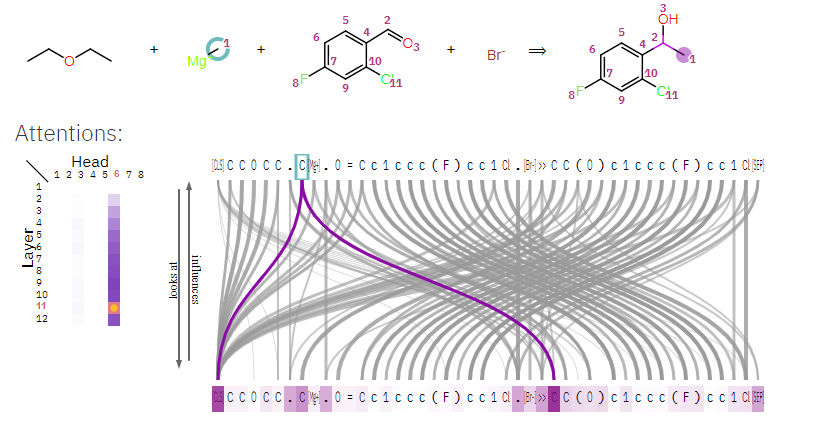
In organic chemistry, we are currently witnessing a rise in artificial intelligence (AI) approaches, which show great potential for improving molecular design, facilitating synthesis and accelerating the discovery of novel molecules. Based on an analogy between written language and organic chemistry, Philippe et al. built linguistics-inspired transformer neural network models for chemical reaction prediction, synthesis planning, and the prediction of experimental actions. They extended the models to chemical reaction classification and fingerprints. By finding a mapping from discrete reactions to continuous vectors, they enabled efficient chemical reaction space exploration. Moreover, the group specialized similar models for reaction yield predictions. Intrigued by the remarkable performance of chemical language models, they discovered that the models can capture how atoms rearrange during a reaction, without supervision or human labelling, leading to the development of the open-source atom-mapping tool RXNMapper. These advances led to the developments of IBM RXN for Chemistry and RoboRXN, the prototype of an AI-driven, cloud-connected, and automated synthesis platform. RoboRXN will enable chemists to execute chemical syntheses from the comfort of their home. Philippe will provide an overview of the different contributions that are at the base of this digital synthetic chemistry revolution.

Image taken from: https://rxnmapper.ai/index.html
Current news

VAST™ Space by XtalPi - Access now with our tools
May 21, 2026 10:42 CEST
The VAST™ Space brings an actionable, navigable universe of 4.66 billion accessible, drug-like products directly into your workflow. Created by XtalPi, this collection was built from 40+ validated reaction protocols and 58,000 in-stock building blocks. By pairing automated synthesis with proprietary feasibility models, it delivers a highly reliable and innovative...
Read on
category
Challenge
Summer 2026 Scientific Challenge Deadline Approaching
May 13, 2026 10:54 CEST
We invite researchers in academia (students, postdocs, professors), non-profit organizations, and individuals to participate in our quarterly Scientific Challenge. Take advantage of our wide array of software to help meet your drug discovery goals. How to Participate Just send us a proposal for the project you would like to advance...
Read on
What's So Special About The 'Activity Spotter'? Detailed Insights Into SeeSAR's New Mode
April 29, 2026 10:22 CEST
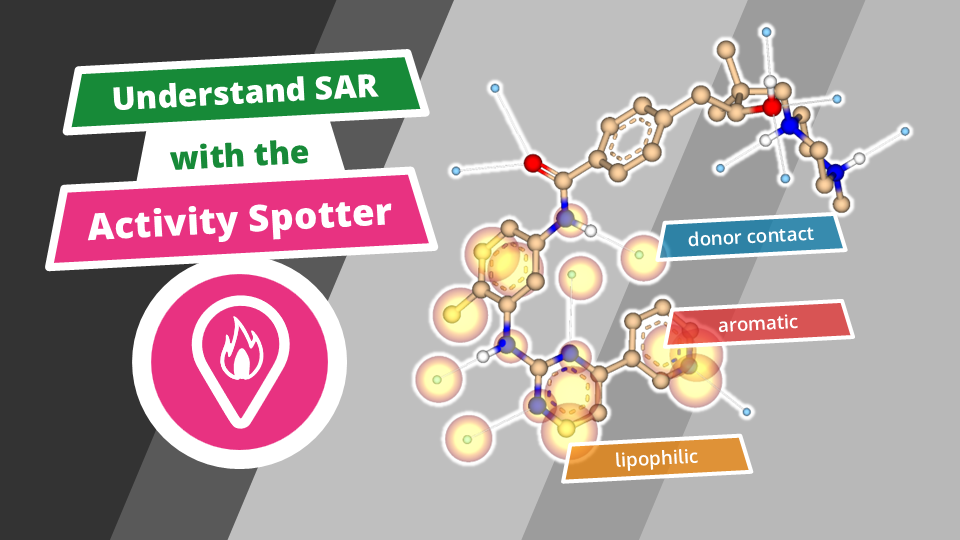
SeeSAR’s Activity Spotter Mode is designed to dismantle the barrier of raw data and actionable SAR. It helps to answer the most relevant fields in hit-to-lead and lead optimization campaigns: 3D SAR and pharmacophore modeling. Which structural features in my molecule set are associated with activity? Which ones are linked...
Read on