







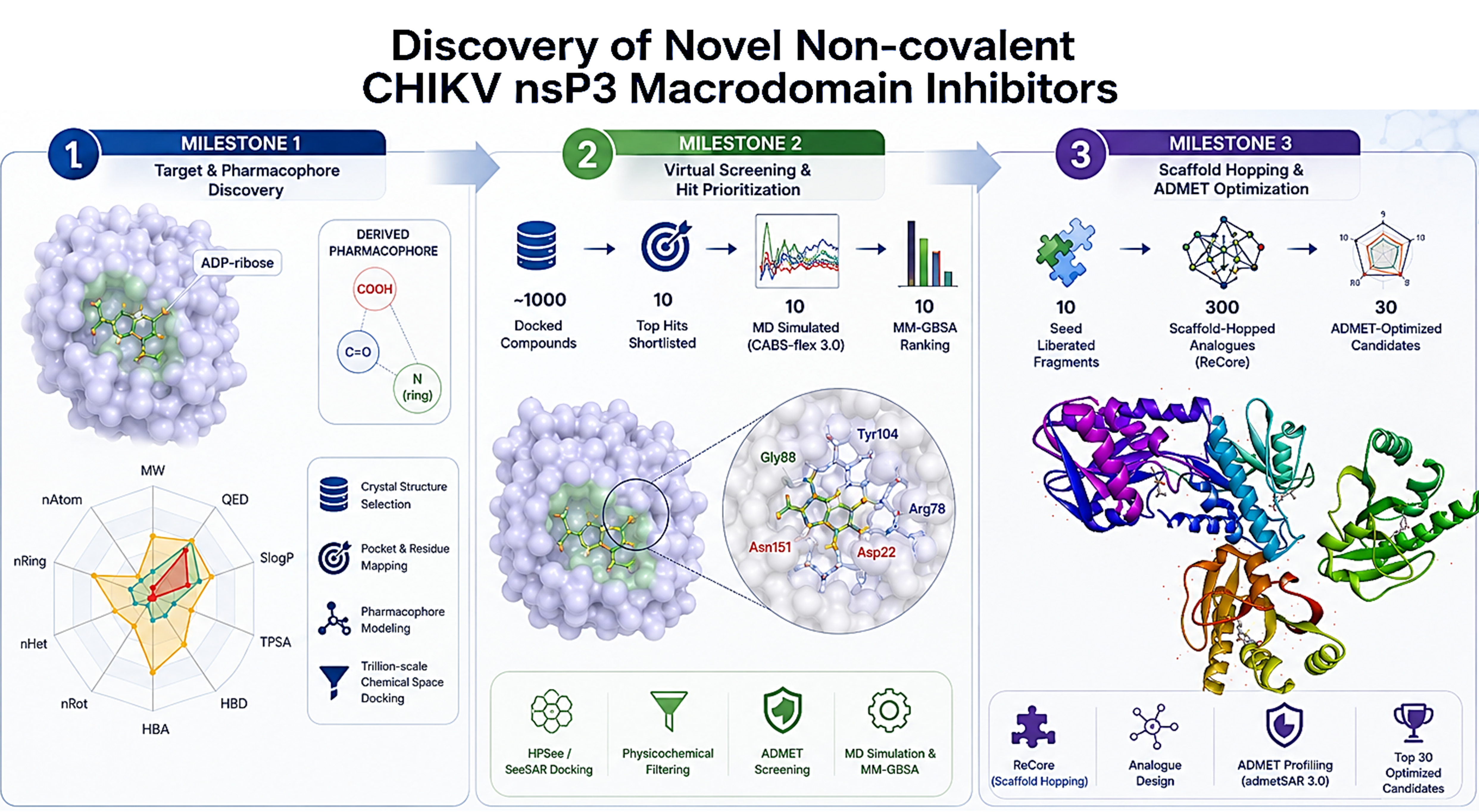
Chikungunya virus (CHIKV) nsP3 macrodomain is an attractive antiviral target because its ADP-ribose recognition and hydrolase activity contribute to viral replication and modulation of host innate immune responses. The objective of the present project was to identify novel, non-covalent small-molecule inhibitors through computer-aided drug-discovery. During the first three months, structural and ligand-based analyses were performed to define a suitable CHIKV nsP3 macrodomain model and characterize its ligand-binding requirements. Reported antagonists were collected from the literature and used to establish pharmacophoric features. These findings guided analogue searching, virtual screening and prioritization of candidate molecules. The most promising compounds were subsequently evaluated by molecular-dynamics, followed by scaffold exploration using ReCore. Newly generated analogues were subjected to ADMET assessment to identify compounds with improved drug-like properties.
After 3 months, Nehal has achieved the following milestones:
- Multiple available CHIKV nsP3 macrodomain crystal structures were compared based on quality, resolution, species, mutation status and sequence completeness as selection criteria. A suitable PDB structure was selected for subsequent computational studies. Reported antagonists and ligands were identified through PubMed, Google Scholar and relevant literature searches and were docked into the selected binding site using BioSolveIT tools. Analysis of the resulting ligand–protein interactions was used to define the principal binding requirements. The resulting pharmacophore retained the carboxylic-acid functionality and the carbonyl oxygen, together with the intervening cyclic nitrogen-containing group and complementary interaction features observed in the docked ligands. Additional chemical libraries were incorporated to expand the screening space.
- The established pharmacophoric and structural requirements were used to search the available chemical space using BioSolveIT-based tools, including VAST, Synple, AMBrosia, CHEMriya and KnowledgeSpace. Approximately 1,000 analogue compounds were identified and subsequently subjected to virtual screening in SeeSAR. Compounds were screened according to their predicted affinity, interaction pattern, structural plausibility and drug-like physicochemical characteristics. ADMET assessment was then applied to the prioritized molecules to remove candidates with unfavorable predicted properties using admetSAR 3.0. Ten of the most promising ligands were selected for further structural evaluation. Molecular-dynamics-based flexibility analysis was performed using CABS-flex 3.0 to investigate ligand–protein complexes and assess the structural stability and adaptability of the binding interactions.
- The selected hits were used as starting points for scaffold exploration and analogue generation with ReCore. Approximately 300 novel structures were generated by replacing or modifying the parent cores (pyrazole, pyrrole, imidazole, 1,2,3-triazole and 1,2,4-triazole) with chemically distinct groups while maintaining the key interaction features identified during pharmacophore and docking analyses. The resulting compounds were subjected to further computational evaluation and ADMET prediction using ADMETlab 3.0. Comparative assessment of the generated analogues enabled compounds with unfavorable predicted properties to be excluded. Approximately 30 compounds demonstrated the most favorable combination of predicted drug-like physicochemical and ADMET characteristics and were retained as prioritized candidates for subsequent structure-based optimization and evaluation.