







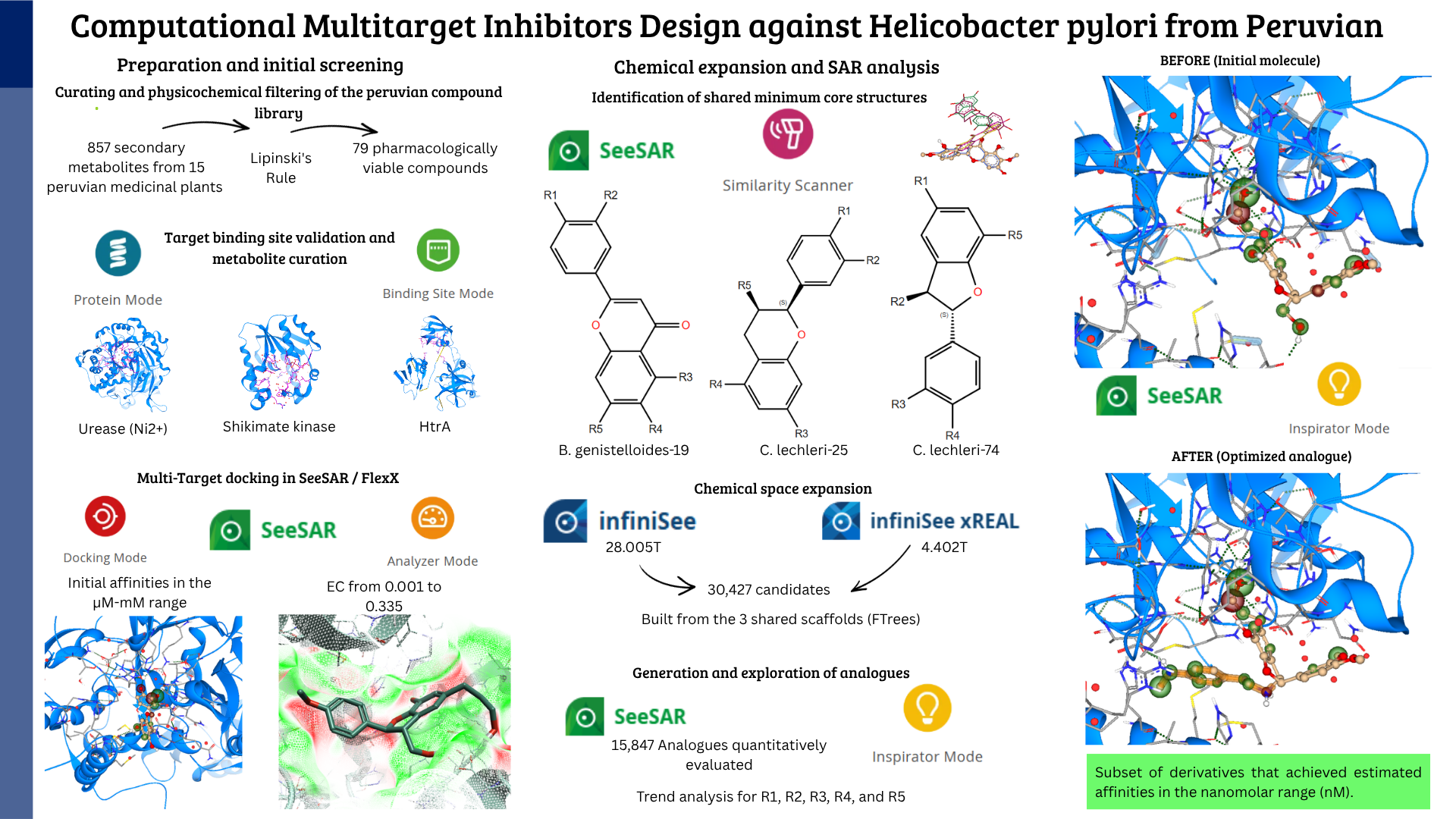
In Q1, catalytic cavities were characterized using DoGSite and validated with co-crystallized ligands in H. pylori Urease, HtrA, and Shikimate kinase. After filtering 857 Peruvian metabolites using CoLibri (75 viable via Lipinski's rule of five), flexible docking in SeeSAR/FlexX yielded top hits based on affinity and HYDE scores (39 for Urease, 40 for HtrA, and 40 for Shikimate kinase), confirming direct coordination with Ni²⁺ in Urease. FTrees identified 3 shared core scaffolds (B. genistelloides-19, C. lechleri-25, and C. lechleri-74) with EC values ranging from 0.001 to 0.335, while infiniSee/xReal generated a chemical library of 30,427 candidates. Initial docking showed moderate affinities and steric clashes. This was addressed by generating 15,847 analogues using SeeSAR Inspirator (R1–R5) and evaluating substitution trends that introduced or resolved clashes, achieving a subset with estimated nanomolar-range affinities across all three targets.
After 3 months, Andrey Justin has achieved the following milestones:
- Milestone 1 was successfully completed through compound library preparation and multi-target docking. A total of 857 metabolites from 15 Peruvian plants were curated using CoLibri, isolating 75 Lipinski-compliant compounds. Catalytic cavities were verified with DoGSite against co-crystallized structures, and docking in SeeSAR/FlexX yielded 39, 40, and 40 top hits for Urease (Ni²⁺), HtrA, and Shikimate kinase, respectively, with initial affinities in the μΜ-mM range. Furthermore, FTrees identified 3 shared scaffolds (B. genistelloides-19, C. lechleri-25, and C. lechleri-74) with EC values ranging from 0.001 to 0.335 across all targets. Chemical space expansion in infiniSee (28.005T) and xReal (4.402T) generated 30,427 compounds alongside 15,847 analogues in Inspirator. This set enabled filtering of steric clashes, comparing favorable versus unfavorable R1–R5 modifications, isolating derivatives with nanomolar (nM) affinity across the three targets, and consolidating lead optimization.
- Milestone 2 is scheduled for Phase 2 (Months 4 to 6), using the chemical library and scaffolds from Milestone 1 for optimization with ReCore and infiniSee prior to quantum validation. Scaffold hopping and fragment replacement will be applied using ReCore and infiniSee to combine optimal R1–R5 substituents onto the 3 core scaffolds, improving HYDE desolvation energy, affinity (nM), and electrostatic complementarity (EC). The resulting shortlist will undergo geometric refinement, HOMO/LUMO analysis, electrostatic potential mapping (MEP), and reactivity descriptor evaluations via DFT calculations in ORCA.
- Milestone 3 is scheduled for the Final Phase (Months 7 to 12) following the quantum validation in Milestone 2. Protein-ligand complexes of the top optimized candidates will undergo molecular dynamics simulations in GROMACS to evaluate structural stability via RMSD, RMSF, and radius of gyration (Rg), complemented by binding free energy calculations to confirm final thermodynamic stability.