







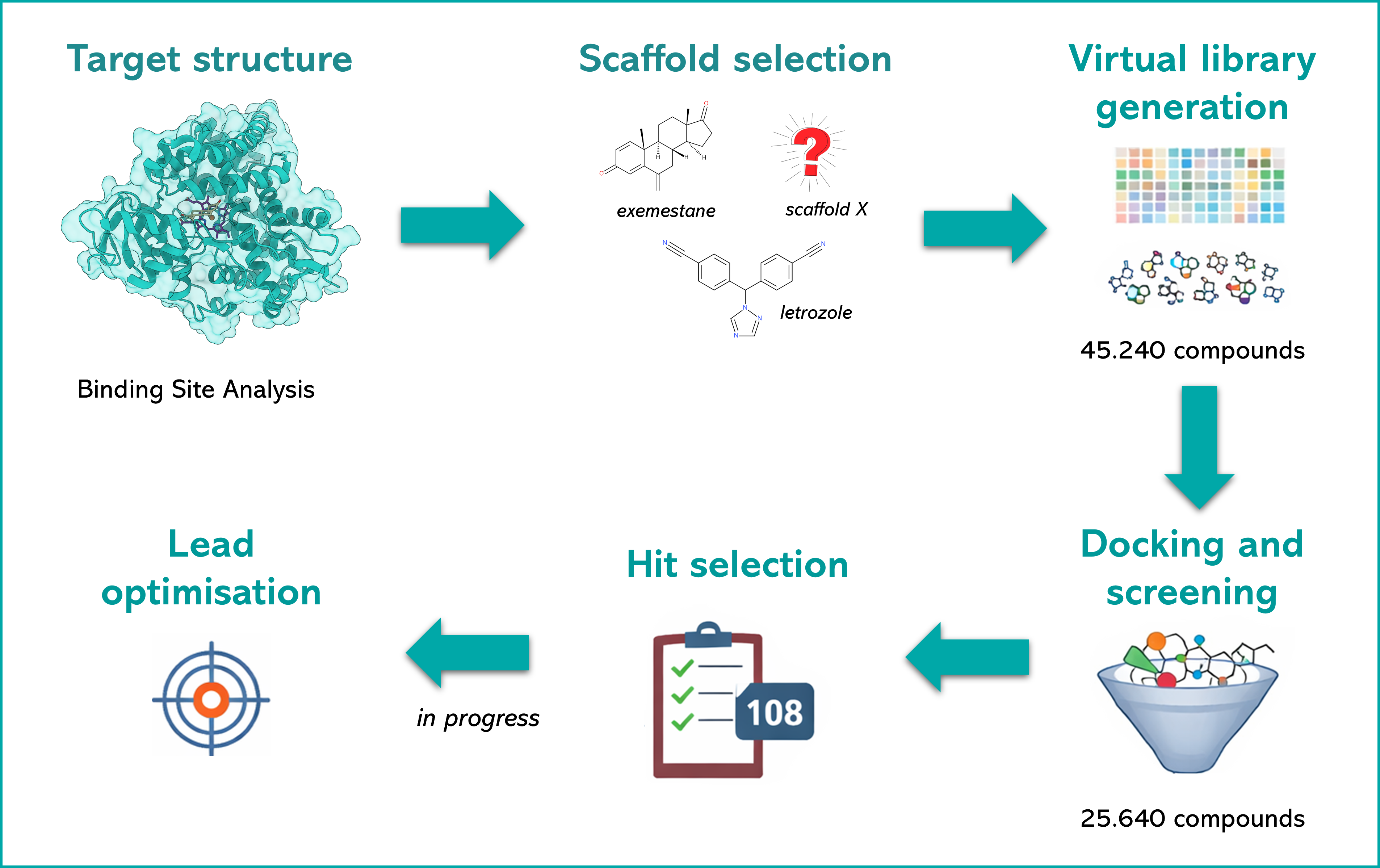
Starting from the human aromatase crystal structure (PDB 3eqm), the active site and adjacent pockets were characterised to define key interaction hotspots. Three scaffolds were selected to explore complementary chemical spaces: exemestane (steroidal), letrozole (non-steroidal), and a hybrid non-steroidal scaffold retaining fundamental interaction motifs to potentially engage both the active site and a nearby sub-pocket. These scaffolds were used as queries in InfiniSee (Scaffold Hopper, Motif Matcher, Analog Hunter), yielding 45,240 unique compounds. Docking into the active site produced 25,640 valid poses, with 5,958 compounds scoring better than 10 μM and 2,385 better than 1 μM. Manual inspection identified 70 promising molecules from scaffold 1, 21 compounds from letrozole, and 17 ones from exemestane, forming a solid basis for subsequent optimisation.
After 3 months, Marialuigia has achieved the following milestones:
- The active site was defined from crystallographic data, enabling precise mapping of key residues and secondary pockets, as well as the recognition of additional regions that could be exploited to enhance ligand affinity. Based on this structural insight, three complementary scaffold families (steroidal, non-steroidal, and hybrid) were selected to ensure broad chemical space coverage. Large scale virtual exploration with InfiniSee, using three orthogonal strategies, produced a curated library of 45,240 candidates. Docking based screening yielded 25,640 valid poses with quantitative affinity estimates, from which 108 high quality hits were prioritized. This process established a robust workflow integrating ligand and structure-based methods for subsequent optimization.
- A comprehensive docking analysis of 25,640 poses enabled prioritisation based on binding mode quality, interaction patterns, and predicted affinity. Key interaction motifs—hydrogen bond donors and acceptors, hydrophobic anchors, and heme proximal contacts—were identified to guide early refinement, while liabilities such as steric clashes, poor orientations, and unsuitable physicochemical traits were filtered out. Cross scaffold comparison revealed both conserved features and unique optimization opportunities. Preliminary SAR from top clusters highlighted modifiable regions and essential pharmacophores. After visual refinement, 108 high quality hits were retained, supporting tailored optimization strategies including fragment growing, pocket extension, and scaffold hopping.
- Lead likeness was assessed through multiparametric criteria, considering affinity, ligand efficiency, lipophilicity, polarity, size, and structural novelty. Pocket extension analysis highlighted compounds able to engage both the active site and the adjacent sub-pocket, while in silico developability profiling evaluated solubility, permeability, metabolic stability, and the absence of structural alerts. From the initial 108 hits, a reduced panel of top candidates was prioritised for their balance of potency, selectivity potential, and synthetic feasibility. Refined binding hypotheses were generated from consistent interaction networks and stable docking poses, supporting advanced modelling to validate binding stability and rank the most promising leads. This process yielded a shortlist of lead-like molecules suitable for synthesis and biological evaluation.