







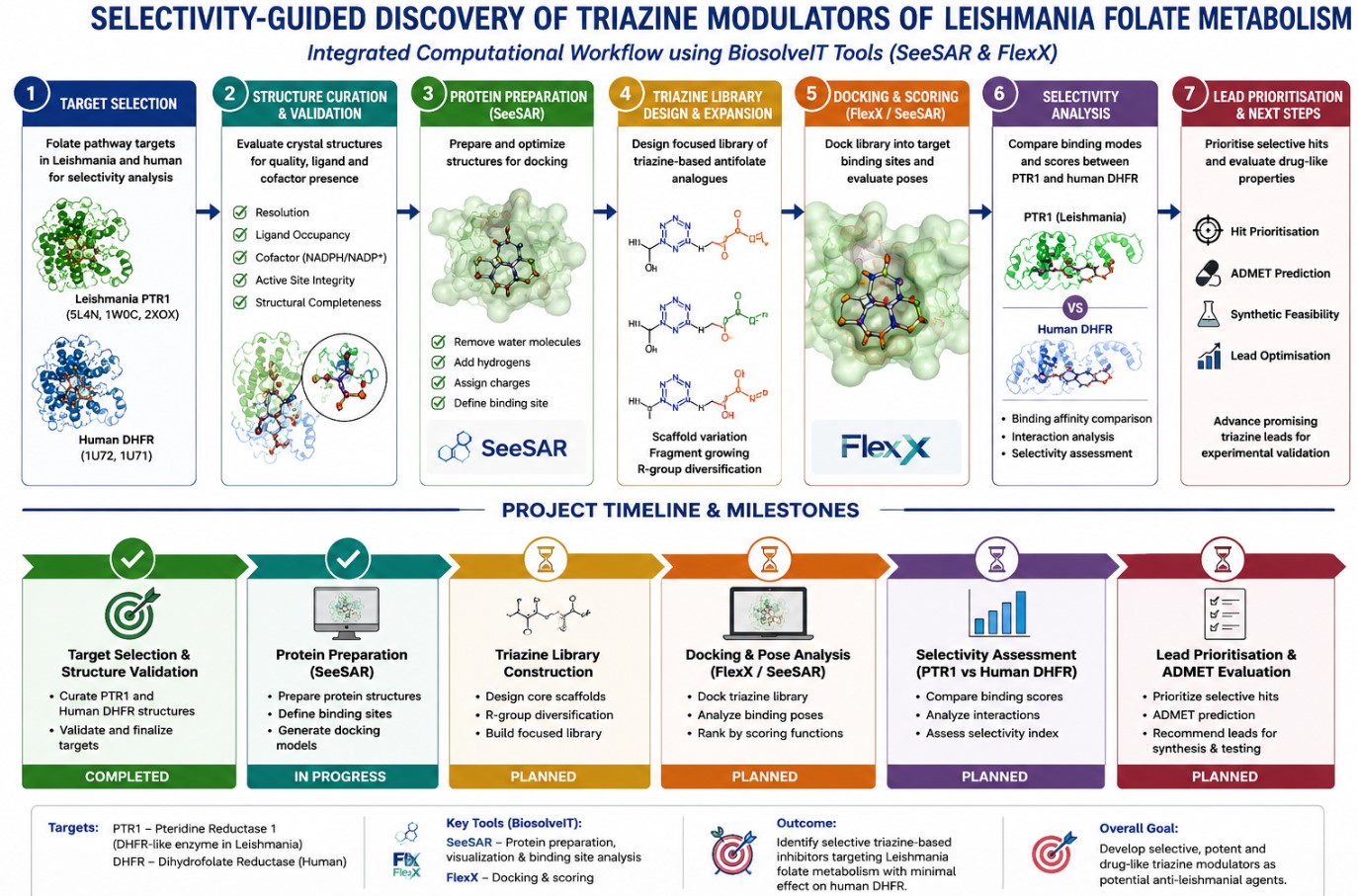
The first phase of the project focused on structure-based target identification and workflow development for selective triazine inhibitor design against Leishmania folate pathway enzymes. Parasite PTR1 and human DHFR structures were retrieved and curated for downstream computational use. Binding sites were identified based on co-crystallized ligands and structural features to support selectivity-guided screening. A preliminary triazine scaffold strategy was outlined for future library construction. In parallel, a BiosolveIT-based workflow framework was established to support protein preparation, docking, and comparative analysis across parasite and human targets. The project is now transitioning from structural validation into protein preparation and virtual screening setup.
After 3 months, Lim has achieved the following milestones:
- Successfully curated a validated structural dataset comprising three Leishmania PTR1 crystal structures (5L4N, 1W0C, 2XOX), two human DHFR structures (1U72, 1U71), and a representative DHFR-TS system (6A2M) for selectivity-guided docking studies. Structures were selected based on resolution, ligand/cofactor occupancy, and active-site integrity. Binding pockets were confirmed through co-crystallized ligand positioning, and preliminary visualisation of PTR1 (5L4N) verified NADPH and inhibitor presence within the active site. A computational workflow was established using SeeSAR and FlexX, covering protein preparation, binding-site definition, triazine library design strategy, docking, and selectivity-based prioritisation. This establishes a complete foundation for subsequent virtual screening and lead identification.
- The foundational framework required for Milestone 2 has been established, enabling progression toward docking and downstream analysis. Protein targets (PTR1, human DHFR, and DHFR-TS) have been curated and structurally validated, with binding sites defined based on co-crystallized ligands. A selectivity-guided screening strategy has been defined to enable parasite–human comparison during docking. A triazine scaffold strategy has been outlined to support future compound library generation. The computational workflow using SeeSAR and FlexX has been configured for protein preparation and docking, ensuring readiness for systematic virtual screening. While full docking, counter-screening, ADMET evaluation, and hit prioritisation are not yet performed, all required structural inputs and methodological components are in place to execute these steps in the next phase.
- Milestone 3 activities are not yet initiated, but the computational pipeline and structural framework necessary for execution have been fully established. Curated parasite and human folate pathway enzyme structures have been validated and organised for downstream docking and selectivity analysis. A structured workflow for virtual screening, comparative binding analysis, and hit prioritisation has been defined, including planned steps for docking, selectivity scoring, and ADMET-informed filtering. The triazine scaffold strategy has been prepared to guide future prioritisation of 20–30 candidate molecules. This milestone will be addressed in the subsequent phase following completion of docking and screening studies, using the established workflow to ensure systematic and reproducible hit identification.