







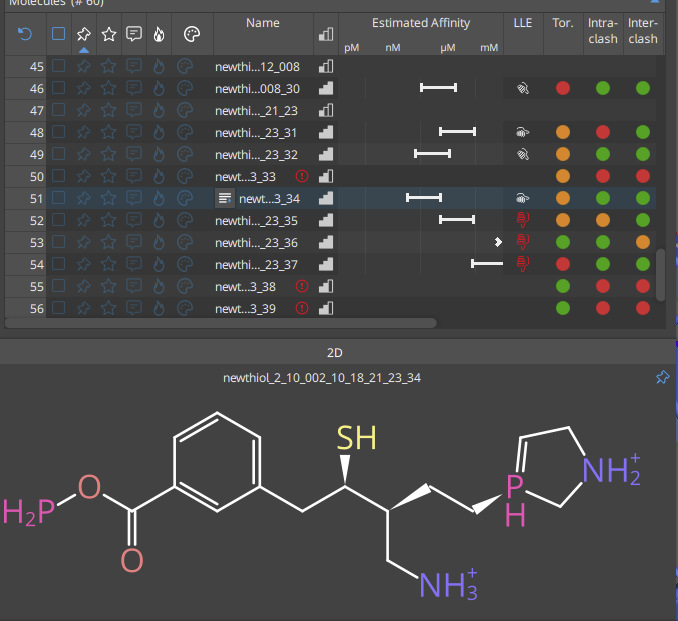
During the first three months, I investigated optimization of NDGA-derived compounds within a β-sheet-associated regulatory region of ALOX15B, aiming for potential noncompetitive binding outside the catalytic iron-containing active site. Identifying this region was initially difficult because it was not the most obvious docking cavity. SeeSAR’s Binding Site Mode, particularly its unoccupied-pocket detection and visualization feature, was essential for highlighting and comparing cavities across the protein. This allowed the regulatory pocket to be identified, refined, and defined for docking. The original NDGA scaffold showed limited favorable interactions, so it was iteratively modified and redocked. Comparison of HYDE affinity, residue contacts, clashes, torsion, and physicochemical properties yielded a preliminary candidate with an estimated affinity of approximately 10–500 nM and favorable clash indicators. Torsional strain and experimental validation remain to be addressed.
After 3 months, Natalia has achieved the following milestones:
- A virtual-screening and docking workflow was established for NDGA-derived compounds targeting ALOX15B. Because the project investigates potential noncompetitive binding, SeeSAR’s Binding Site Mode and unoccupied-pocket visualization feature were used to identify and compare cavities outside the catalytic iron-containing active site. A β-sheet-associated regulatory pocket was selected and manually refined as the docking region. The original NDGA scaffold and multiple structurally modified derivatives were then docked into this defined site. Their generated poses and HYDE-estimated affinity ranges were inspected, confirming that the selected non-active-site pocket could accommodate NDGA-derived structures and providing the docking results required for subsequent candidate evaluation.
- Docked candidates were evaluated and prioritized according to predicted binding stability, residue interactions, and drug-like properties. HYDE-estimated affinity ranges and binding orientations were compared together with residue contacts, torsional quality, intra- and intermolecular clash indicators, molecular weight, LogP, and TPSA. This process identified a preliminary candidate with an estimated affinity of approximately 10–500 nM and favorable green intra- and intermolecular clash indicators. The orange torsion indicator revealed possible conformational strain, preventing final optimization. This milestone established a rational ranking process and prioritized a computational lead while identifying the principal limitation requiring further refinement.
- The prioritized scaffold was optimized through iterative modification of selected atoms, functional groups, and substituent positions, followed by repeated redocking and reassessment. The goal was to improve predicted affinity and interactions within the β-sheet-associated regulatory pocket while monitoring torsional strain and physicochemical properties. This generated a preliminary lead that can serve as the starting structure for future pharmacophore modeling and fragment-based growth or replacement. The milestone was partially reached because a lead scaffold and clear optimization strategy were established; additional refinement and experimental validation are required before translational therapeutic development can be considered.