







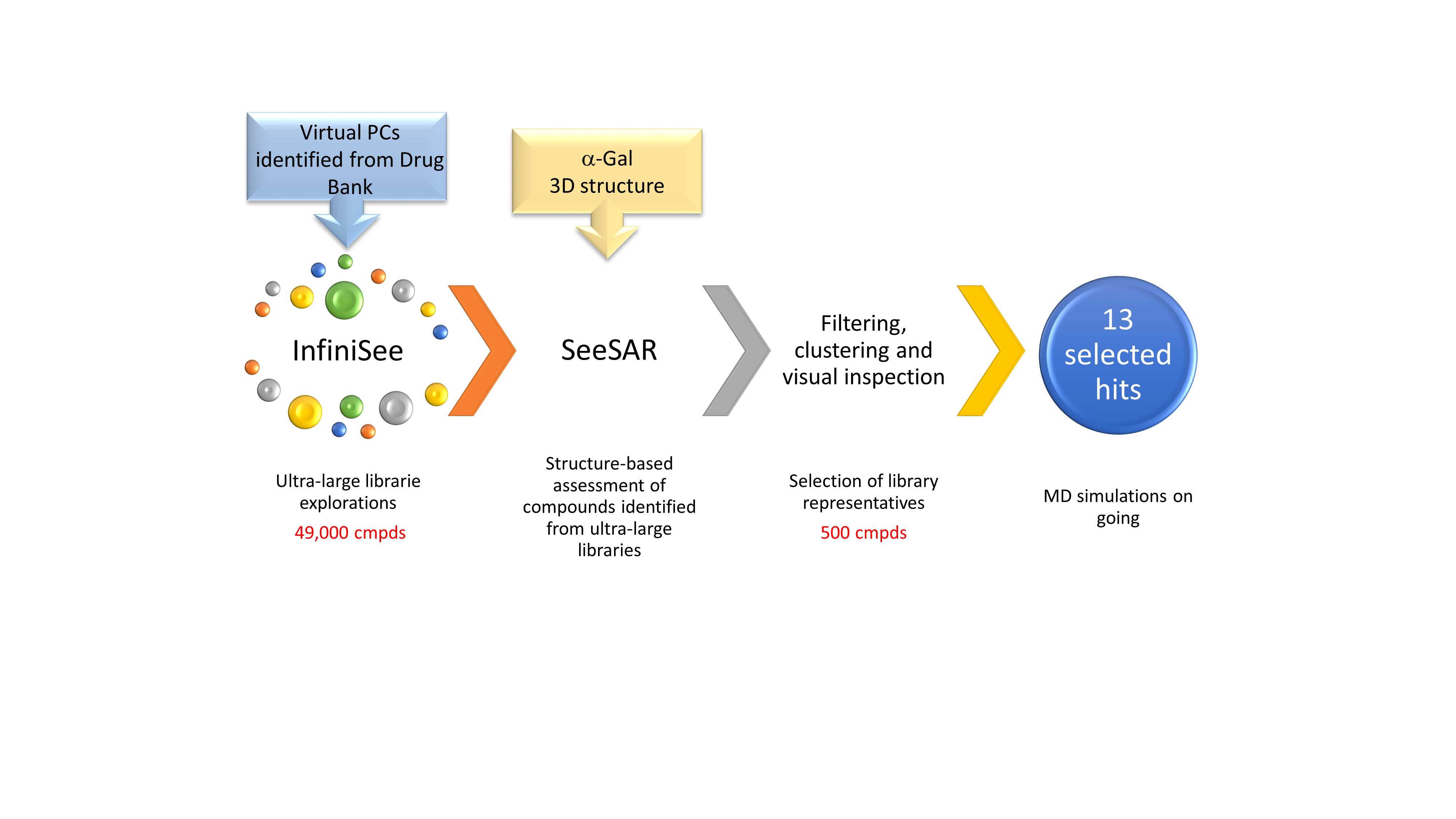
We developed a virtual screening workflow focused on the identification of new allosteric pharmacological chaperones (PC) binding the wild-type alpha-GalA. We hypothesize that molecules able to firmly bind the allosteric site of the wt can retain this affinity toward mutated variants. Thus, the binding of PC stabilizes the protein preventing its degradation and promoting its transport to the lysosome. In particular, we aimed to identify new scaffolds with the correct geometric and electronic complementarity for the allosteric site that could maintain a stable bond with key residues necessary to the enzyme stabilization. The explored binding site, identified previously, is solvent exposed and flexible providing issues to the application of standard structure-based methods. The exploitation of the BioSolveIT programs combining the screening of ultra-large libraries followed by docking refinement provided a final set of promising low MW ligands that are under validation through MD simulation.
After 3 months, Mariangela has achieved the following milestones:
- The protocol was based on an initial drug repurposing strategy applied to the DrugBank database, aimed at identifying known drugs capable of binding to the allosteric site of -GalA under neutral pH through docking calculations using AutoDock Vina. This screening afforded six compounds that interact directly with key residues at the allosteric site. These compounds along with alpha-galactose, were used to feed the InfiniSee ligand-based screening. In particular, the Scaffold hopping module of InfiniSee was exploited to explore the available commercial libraries. In order to calibrate the software’s output and ensure balanced chemical sampling, the search parameters within InfiniSee were set by limiting the maximum number of molecules generated to 1,000 per run, with a target similarity value of 1 and a minimum similarity threshold of 0.5. At the end of the procedure we collected a set of 1000 compounds per scaffold per library affording a final set of 49,000 compounds.
- The library obtained in the previous stage was docked on the allosteric site of -GalA using SeeSAR. Preliminarily, the docking protocol was setup by tuning the calculation parameters to re-obtain the experimental geometry of the co-crystallized ligand (-galactose). To this aim the default setting of the binding site definition was modified reducing from 11 to 6 the number of amino acids forming the binding site. This choice was allowed to address the binding to key residues necessary to the stabilization effect and is reasonable as ligands are fragment-size. This setting allowed us to obtain a good alignment between calculated and experimental coordinates of -galctose and was used to screen the 49,000 compounds obtained in the previous stage. In particular, the Standard Docking Module of SeeSAR was used saving a maximum number of poses equal to 1, not allowing ring conformations generation, exploring stereo center flipping and setting a default clash tolerance.
- The screening generated a massive volume of data, making it essential to apply a post-processing strategy to select the most promising candidates. To this end, we developed a combined protocol of filtering and hierarchical clustering through the KNIME software. A Knime workflow was defined using RDKit to calculate molecular properties and Morgan fingerprints. The workflow eliminates compounds with stereocenters and perform hierarchical clustering obtaining 10 cluster per explored library and selecting 1 representative compound per cluster. Obtained compounds in their docked geometry were visually inspected to check the presence of key interactions in the binding site, and the synthetic feasibility. The final selection afforded a set of 13 compounds characterized by diverse scaffolds and numerous interactions in the binding site. The MD simulations of the obtained complexes are ongoing to check the stability of the binding and the stabilization effect on the enzyme.