







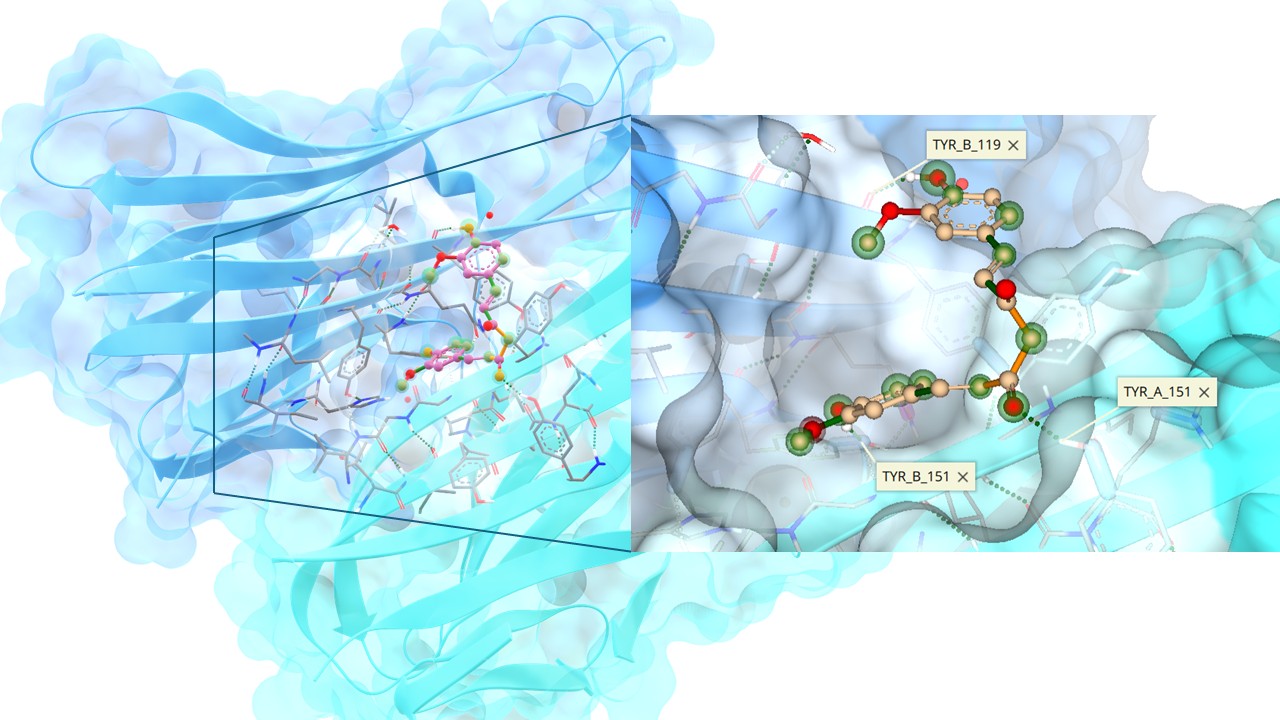
During the first three months, TNF-α (PDB ID: 2AZ5) and bromelain (PDB ID: 6YCF) structures were prepared in SeeSAR. For TNF-α, only the dimer-forming chains were retained to preserve the validated small molecule pocket. Binding sites were defined using co-crystallized ligands and validated via redocking prior to screening. Five phytochemicals (gallic acid, rosmarinic acid, andographolide, catechin and curcumin) representing chemically diverse anti inflammatory scaffolds were docked using FlexX and evaluated by HYDE scoring. Initial obstacles of multimeric TNF geometry and high ligand polarity were addressed through chain refinement and careful pose selection without steric clashes. Binding site analysis and hydrogen bond mapping identified scaffold-dependent interaction patterns across both targets, establishing validated docking protocols and promising starting points for subsequent chemical space exploration.
After 3 months, Fatahiya has achieved the following milestones:
- Milestone 1 was successfully achieved through validated preparation of TNF-alpha (PDB ID:2AZ5) and bromelain (PDB ID: 6YCF) structures and establishment of reproducible docking workflows in SeeSAR. Binding sites were defined using co-crystallized ligands and confirmed by redocking to ensure structural accuracy. The five phytochemicals were docked against both targets using FlexX and evaluated via HYDE scoring. Binding site mapping and hydrogen bonds formation revealed scaffold dependent interaction patterns and identified initial dual-target binding tendencies. This milestone established reliable docking protocols, validated pocket definition, and generated prioritized starting scaffolds for chemical space refinement in the next stage.
- Although full chemical space exploration has not yet been executed, Milestone 1 established validated binding pockets and scaffold dependent interaction trends for both TNF-alpha and bromelain. The identified interactions in TNF-α and bromelain provide clear structural hypotheses for analogue expansion. The docking workflow, scoring parameters, and pose validation procedures are now standardized, enabling systematic chemical space exploration and prioritization of dual-binding derivatives in the next phase.
- Refinement and final hit selection have not yet been performed, but Milestone 1 generated ranked binding poses and interaction fingerprints that define clear optimization criteria. Identified scaffolds demonstrate differential target engagement, forming the basis for guided structure refinement. The validated docking environment and reproducible scoring workflow establish a robust framework for comparative analysis, derivative prioritization, and final candidate selection in the subsequent phase.