







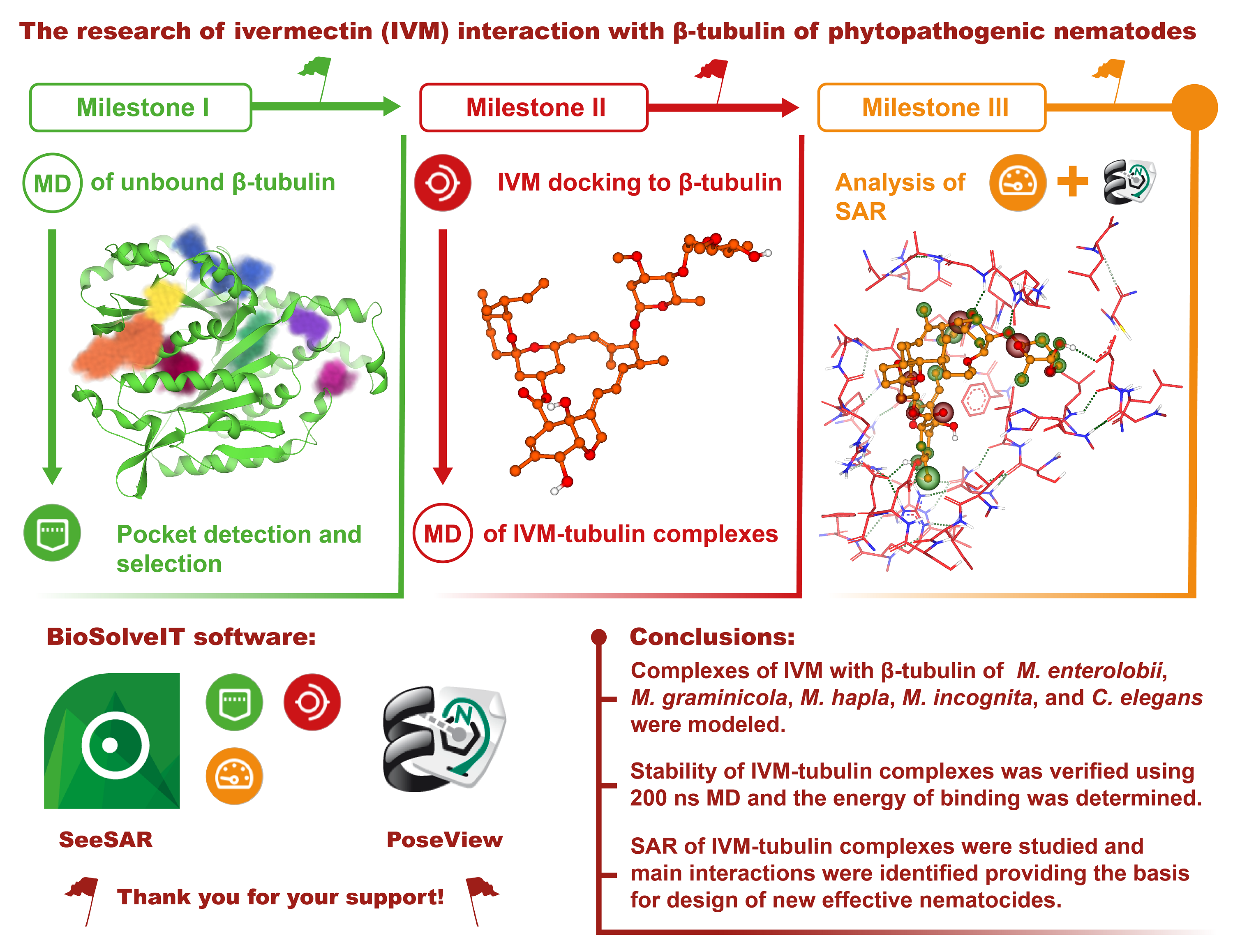
During the twelve months of the project all three milestones were reached. Initially, the conformations of unbound β-tubulin of M. enterolobii, M. graminicola, M. hapla, M. incognita, and C. elegans were collected using 200 ns molecular dynamics simulations. The major conformational states were determined and extracted from the trajectories. Using the Binding Site Mode of SeeSAR cavities on the surfaces of extracted conformations were identified and filtered based on their volume and shape. Further, the molecular docking of ivermectin (IVM) to each selected conformation was done using FlexX embedded into SeeSAR (Docking Mode). The geometry and affinities of obtained complexes were analyzed in the Analyzer Mode of SeeSAR. Finally, the 200 ns molecular dynamics simulations of best complexes were performed and the resulting trajectories of IVM-tubulin complexes were analyzed. The free energy of IVM binding to β-tubulin of each studied nematode was determined for collected conformations using MM/PBSA method (gmx_MMPBSA tool). The contributions of IVM atoms to complex affinities were determined using HYDE method of SeeSAR. Analysis of IVM-tubulin interactions was performed in 3D using SeeSAR Analyzer Mode and 2D using PoseView. Considering contributions of IVM atoms to binding energy of complexes, SAR of IVM interactions with β-tubulin were established laying the foundation for design of new effective nematocides based on IVM structure.
After 1 year, Yevhen has achieved the following goals:
- Milestone 1. To collect conformations of unbound β-tubulin using molecular dynamic and to select optimal conformations for molecular docking. Achievement(s). Classical molecular dynamics simulations of unbound β-tubulin of M. enterolobii, M. graminicola, M. hapla, M. incognita, and C. elegans were performed using GROMACS. The cluster analysis of collected conformations of each target was done and the middle conformations of determined clusters that occur with high frequency were identified and extracted from the trajectories. Binding pockets were further detected and analyzed in the SeeSAR’s Binding Site mode. Conformations of the predicted binding site with optimal shape and volume compatible with IVM were selected for the molecular docking.
- Milestone 2. To create IVM-tubulin complexes using molecular docking and to perform molecular dynamics simulations of best solutions. Achievement(s). Molecular docking of IVM to the predicted binding site was performed in the Docking Mode of SeeSAR for selected conformations of each studied structure. The obtained complexes of IVM and β-tubulin were analyzed in the Analyzer Mode of SeeSAR. Based on affinity and geometrical properties the best complexes were selected for simulations. The molecular dynamics simulations of IVM bound to β-tubulin of M. enterolobii, M. graminicola, M. hapla, M. incognita, and C. elegans were performed.
- Milestone 3. To determine SAR of IVM-tubulin complexes and to highlight perspectives of further research. Achievement(s). The free energy of IVM-tubulin complexes’ was determined using MM/PBSA method. The contributions of IVM atoms and thus role of its functional groups in maintaining stability of complexes were determined using the HYDE method of SeeSAR in combination with the 2D schemes of interactions generated by PoseView. The identified SAR of IVM-tubulin complexes will further be used in virtual screening and for the design of new potent nematocides based on IVM scaffold.