







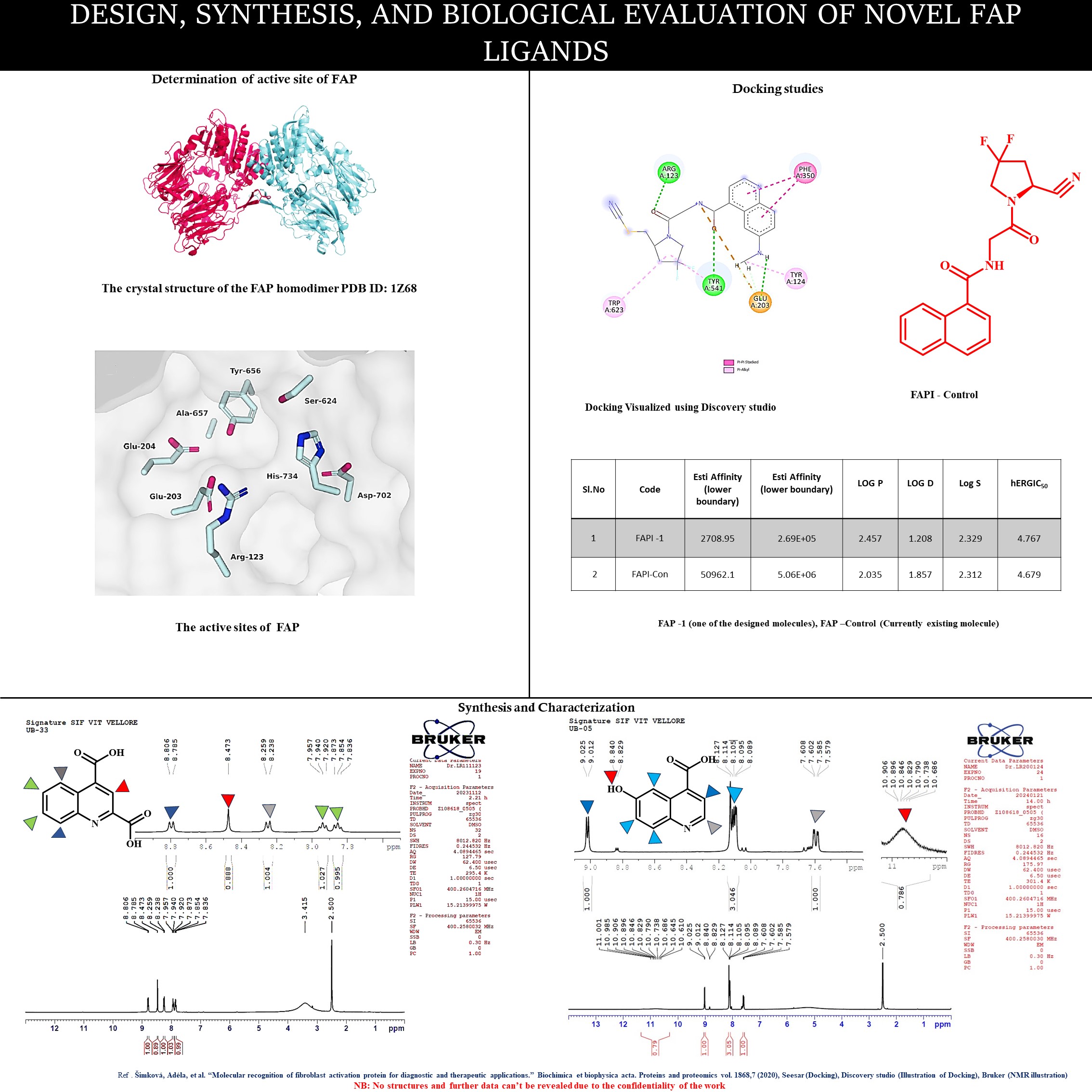
In the first part of the work, we reviewed the literature and designed some ligands based on our literature studies. The FAP binding affinity of such ligands is studied using the Seesar software. To do docking studies, our first approach was to determine the active site of FAP. Besides the catalytic triad composed of the Ser624, Asp702, and His734, the residue Arg123, Glu203, Glu204, Ala657, and Tyr656 are responsible for the substrate binding. The activity studies of the ligand designed were done using the seesar, and a set of ligands with good affinity was chosen for synthesis and characterization. Currently, the synthesis and characterization work of the ligands is going on. Future work will include the Complete synthesis of ligands and characterization and purification. The ligand will then be subjected to the in-vitro studies using a U87MG cell line using a suitable assay. The best ligand will be selected for the in-vivo studies
After 3 months, Unnikrishnan has achieved the following milestones:
- Step -1 • The active site of the protein and its closest analogs are identified using a literature survey • The previously existing FAP ligand’s structure is collected. • Previously existing ligands are docked using seesar. • Possible modifications to previously existing ligands are done according to the literature survey (Some molecules are designed using the inspirator mode in Seesar). • The designed molecules (around 30 molecules) are docked via Seesar • The best docking results are tabulated Bottleneck Many times, the software failed to work properly in my system. The software shut down while the docking was going. The software failure was the main issue we faced. The software only has the affinity range. It does not give any idea about the exact value of our affinity. We need other software for exact binding affinity values and docking scores.
- Step -2 • The synthetic plan for synthesizing the ligands was designed according to the literature. • The synthesis was started, and synthesized compounds were purified by column and flash chromatography. • The synthesized compound was characterized by 1H, 13C NMR, IR and UV and HRMS spectra. Bottlenecks The main bottleneck in the synthesis was the purification step involved in the synthesis. Many compounds were difficult to purify.
- No biological studies have been done yet.After complete synthesis biological studies will be done.