







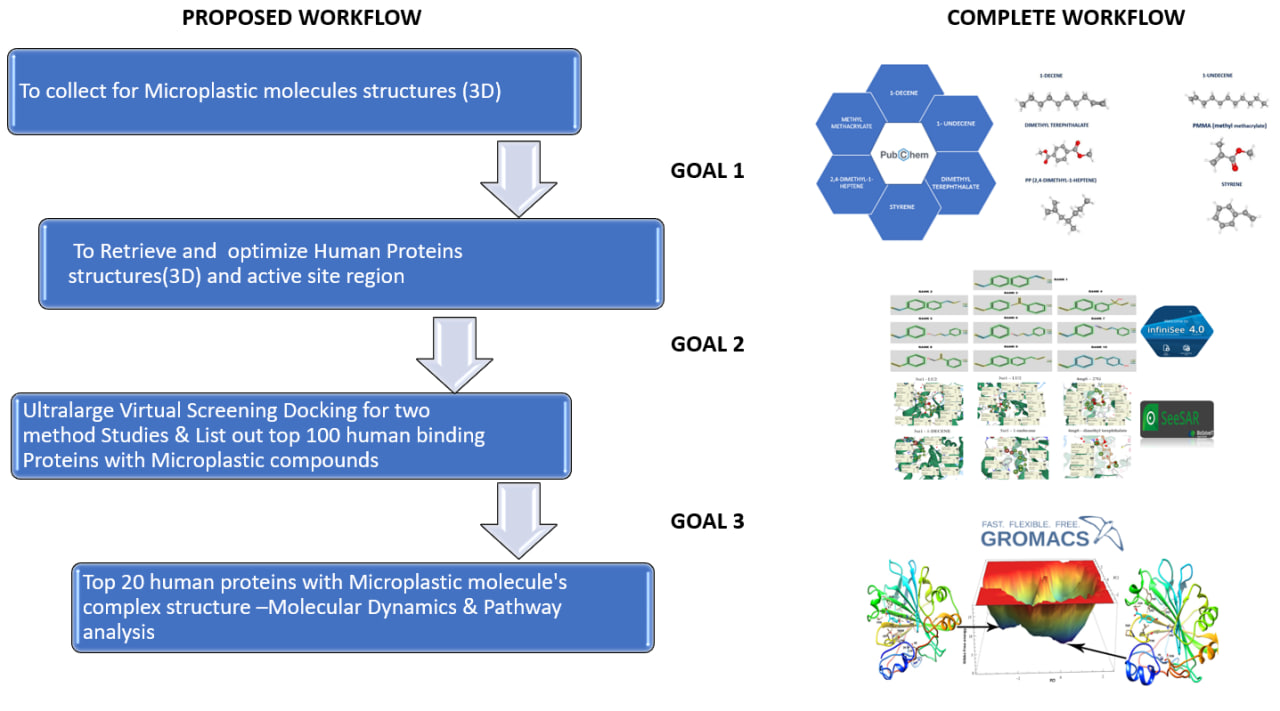
Summary: The study combined the toxic effect of microplastic compounds on human protein was studied using ligand-based virtual screening, molecular Docking and Molecular Dynamic approaches.
A total of six microplastic compounds were selected for the study based on literature review and the 3-D SDF structures were downloaded by PubChem. The six microplastic compounds include 1-decene, 1-undecene, dimethyl terephthalate, methyl methacrylate, 2,4-dimethyl-1-heptene, styrene. A similarity search using FTrees algorithm under infinisee software was performed to find out the human metabolic compounds similar to the above microplastic compounds. The FTrees approach provided an efficient search from the 217776 molecules of Human Metabolome Database (HMDB) and filtered top 10 hit molecules with a similarity score of 1- 0. 956. In the next step, the human protein interaction with above six microplastic compounds were carried out by a ligand-based target identification and activity prediction online server, ligTMap. Among the six microplastic compounds, three of the compounds does not have any binding affinity with Human proteins by LigTMap. Among the three microplastic compounds, dimethyl terephthalate shows a moderate affinity with Carbonic Anhydrase 2. The ligTMap interaction proteins were further docked with the microplastic compounds. The shortlisted compounds were undergone Virtual Screening Technique using SeeSAR software. Following that, single poses of selected ligands were evaluated using HYDE calculations. In the next step, HYDE binding assessment approximates and visualizes binding affinities. The prediction of ligand binding affinity was addressed and calculated the realistic Free Energies of binding and pinpoints affinity problems if a ligand is bound. Finally, the identified hit molecules were compared with other molecules using SeeSAR software and infer the binding mode. The estimated affinity of Human protein and ligand were estimated using SeeSAR software. This study infers that the Carbonic Anhydrase 2 protein interaction with Dimethyl terephthalate using Biosolve IT (infinisee and SeeSAR) tools. The proposed study found the potent and selective Human Proteins interacting with these microplastic compounds study for molecular Dynamics studies and may have prognostic effect on various pathways.
After 1 year, Muthukumaran has achieved the following goals:
- Identification of Microplastic Similar Compounds from Human Metabolome Database using Infinisee Software: A total of six microplastic compounds (1-decene, 1-undecene, dimethyl terephthalate, styrene, 2, 4-dimethyl-1-heptene, methyl methacrylate) were identified to be similar with the molecules of Human Metabolome Database (HMDB) were selected for the study. The infinisee software, using FTrees algorithm, provided an efficient search from the 217776 molecules of Human Metabolome Database (HMDB) and finds the top 10 hit molecules that are similar to the microplastic with a similarity score of 1- 0.956.
- Goal 2: Virtual Screening of Human Proteins using SeeSAR Software & HYDE Calculation – An Interactive and iterative optimization of leads: The human protein interaction with six microplastic compounds were carried out by a ligand-based target identification and activity prediction online server, ligTMap. Among the six microplastic compounds, 3 of the compounds does not have any binding affinity with Human proteins. whereas one among the protein has strong association with Carbonic Anhydrase 2 (CA 2). The ligTMap interaction proteins were further docked with the microplastic compounds. The shortlisted compounds undergone Virtual Screening Technique using SeeSAR software. The single poses of selected ligands were evaluated using HYDE calculations. The identified hit molecules were compared with other molecules using SeeSAR software to predict the binding mode. The estimated affinity of Human protein and ligand were estimated by SeeSAR software.
- Goal 3: Molecular Dynamics studies for the human protein complex (CA 2) with top hit microplastic molecule (Dimethyl terephthalate): The GROMACS 4.5.4 molecular dynamics package assessed the stability of the complex between 5O6 and dimethyl terephthalate with CA 2 protein. Trajectory analysis of CA 2 protein interaction with 5O6 and dimethyl terephthalate indicates minimal conformational changes and high stability (RMSD: 0.15-0.2 Å). RMSF plot shows distinct residue fluctuation differences in the 5O6 and dimethyl terephthalate complex of CA 2. Gibbs energy analysis of the MD simulated trajectory reveals higher energy for the dimethyl terephthalate complex compared to 5O6 CA 2 protein complex. Outcome of the proposal work shows dimethyl terephthalate may modulate human pathways and function by interacting with CA 2 protein. However, in-silico studies require validation through future in-vitro experiments.