Chemical Space Expansion

Enriching compound hunting grounds with tailored chemistry Chemical Space Expansion

Chemical Space Expansion: Augmenting Diversity and Novelty

The motto “bigger is better” has repeatedly proven true for compound catalogs: a larger selection typically comes with broader chemical coverage and more potent binders.
This makes the prospect of expanding a Chemical Space, either strategically or exploratively, with in-house reactions and building blocks particularly exciting. The result is an even larger chemical universe containing tailored chemistry and project-relevant compounds. This is the concept behind Chemical Space Expansion.

Chemical Space Expansion is one of BioSolveIT's CRO services.

How Does Chemical Space Expansion Work?

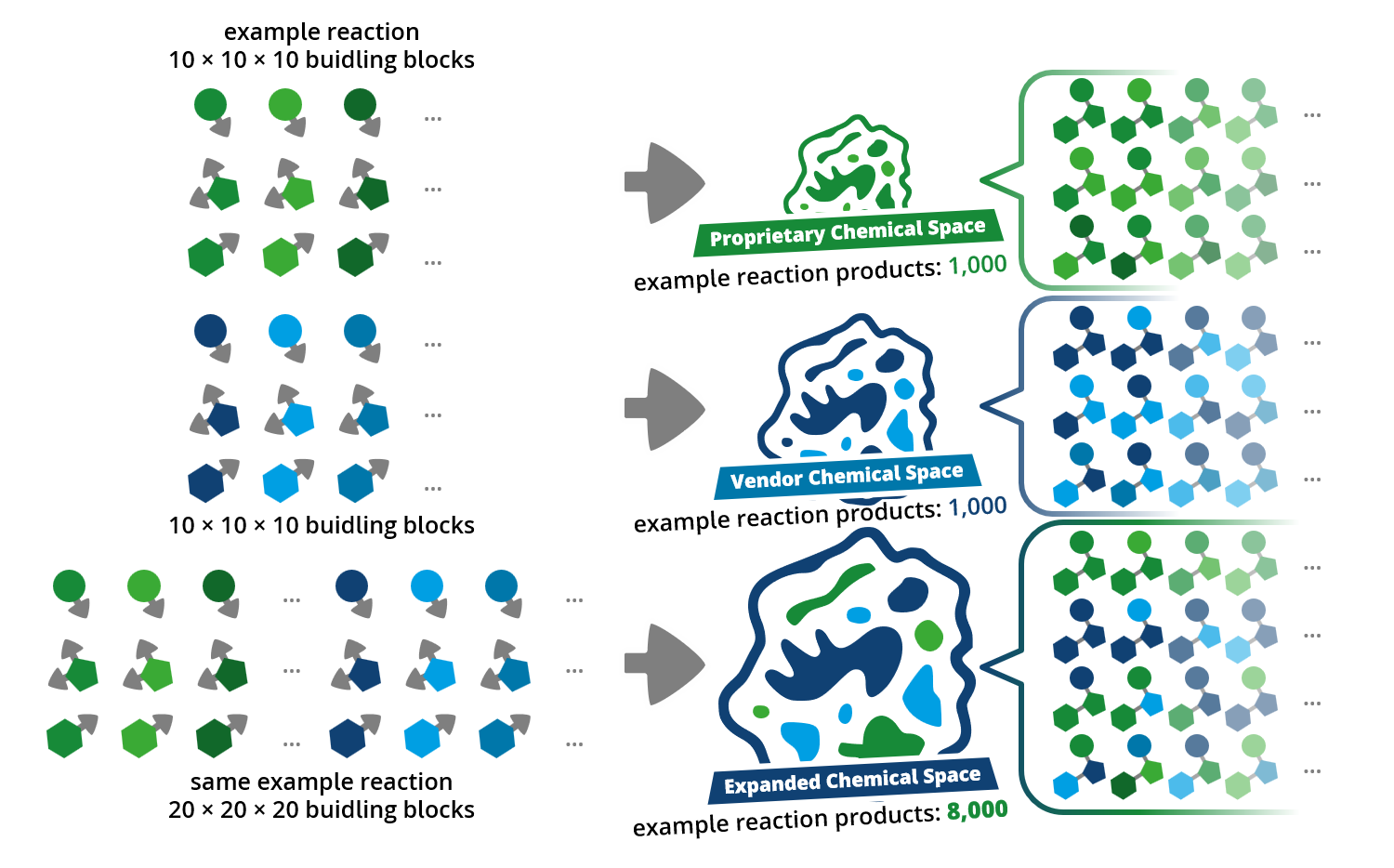
Chemical Space Expansion combines two sources: building blocks and/or reactions from a compound vendor (e.g., Enamine) with the proprietary resources of the customer’s institution.

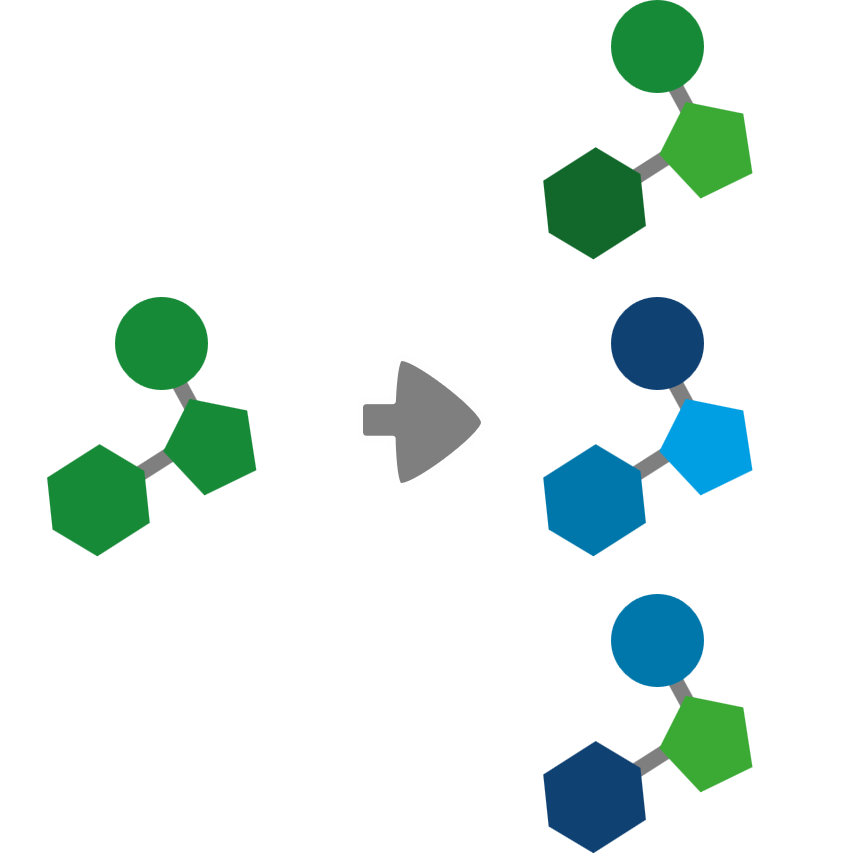
The aim is to leverage synergies between both datasets and enrich the resulting space with relevant chemistry. Existing scaffolds and clusters are populated with new analogs, while blind spots are addressed through cross-combinatorial chemical diversity. This leads to more comprehensive coverage of the chemical possibilities represented by the Space, as well as a higher density of accessible compounds around clusters of interest.

What makes this especially powerful is that exponential growth works in our favor. Due to the combinatorial nature of the process, the number of possible compounds grows far beyond simple addition. More building blocks and more reactions can generate Chemical Spaces that are several orders of magnitude larger.

What Are the Use Cases for an Expanded Chemical Space?

  • Hit Expansion and SAR: This is the classic scenario following the identification of a hit compound in a virtual screening campaign.
    The hit has been found, but what comes next?
    Analogs are needed to establish structure–activity relationships. The fastest route often leads through the compound catalog, guided by the question: Which analogs can I buy to save time and money? An Expanded Chemical Space can provide a much broader range of synthetically accessible analog options at this stage.
    For in-house synthesis, the required precursors can be ordered, while the final coupling step is performed internally using proprietary building blocks.
  • Tailored Libraries: Ultra-large catalogs make it possible to mine substantially more compounds. This can be used to build focused libraries that once contained only hundreds or thousands of compounds, but can now be expanded to several million entries for follow-up screening.
  • General Chemical Space Screening: Naturally, an Expanded Chemical Space can also be used for conventional 2D and 3D hit searches. Its broader chemical coverage provides a much larger hunting ground for discovering relevant chemistry.

Strategic Benefits

Chemical Space expansion combines external resources with proprietary chemistry to create broader, more relevant, and synthetically accessible discovery opportunities. Key benefits include:
  • Reduced project risk and wasted synthesis
  • Shorter DMTA cycles
  • Better utilization of proprietary chemistry
  • Greater novelty and differentiation
  • More comprehensive SAR coverage
  • Synthetically accessible compounds
  • Access to chemistry beyond conventional catalogs
  • A reusable resource for future discovery campaigns

Driving Proprietary Chemistry

Internal reactions and building blocks become searchable assets rather than isolated knowledge. The expanded Chemical Space can systematically exploit chemistry that other will not have access to.

Greater Novelty and Differentiation

By combining two or more resources and leveraging the resulting synergies, new analogs and chemotypes become accessible that are not represented in standard catalogs. This helps researchers move beyond previously explored chemical matter and create more differentiated intellectual property.

Richer than a Catalog

Unlike conventional catalogs, a Chemical Space also contains compounds that have not yet been listed or synthesized. This makes it vastly richer in potential chemistry and provides access to structures that might never emerge elsewhere.

Tangible Chemistry

Thanks to the architecture of the Chemical Space concept, the resulting compounds are synthetically accessible. Customers can either have selected compounds synthesized by the compound vendor or order the required precursors and perform the final step in-house, saving both time and money.

More Comprehensive SAR Coverage

A wide range of search methods is available for exploring the Space, including fuzzy pharmacophores, molecular fingerprints, and substructure searches. The latter particularly benefits from SMARTS support, enabling targeted searches for desired substitutions and systematic mapping across different substitution vectors.

A Reusable Discovery Resource

Once created, the Space can be used not only to advance a single active series, but also to support future discovery campaigns. This includes 3D structure-based virtual screening as well as 2D methods such as scaffold hopping and hit expansion.

How Can I Search the Expanded Chemical Space?

2D: infiniSee

infiniSee is a Chemical Space navigation platform with an intuitive GUI that retrieves compounds based on different aspects of molecular similarity.

2D: FTrees (Scaffold Hopper)

Rapidly identifies structurally diverse compounds with similar functionalities, enabling scaffold hopping and exploration of novel core chemistries.

2D: SpaceLight (Analog Hunter)

The fastest method (though all are exceptionally fast) for identifying close chemical analogs in the chemical proximity of a compound of interest to enable SAR exploration.

2D: SpaceMACS (Motif Matcher)

Searches for defined substructure and shared common motifs to find compounds sharing key functional features.
CLI supports SMARTS searches.

3D: Chemical Space Docking®

Structure-based exploration of ultra-large combinatorial spaces to discover novel, synthetically accessible binders with favorable interactions in the target's binding site.

How Can I Search the Expanded Chemical Space?

FTrees, SpaceLight and SpaceMACS are available as stand-alone command-line tools, as well as Modes in infiniSee.
Chemical Space Docking® can be accessed within SeeSAR in combination with HPSee.

Vendor Chemical Spaces

We run several collaborations with trusted partners (e.g., Enamine, eMolecules, XtalPi, ...) who provide their Chemical Spaces as the largest compound catalogs available for users to search. In an on-demand model, requested compounds are then synthesized and shipped to the end customer, giving them access to the maximum possible number of synthesizable molecules.

If you would like to make your own expanded Chemical Space in collaboration with us, please contact us via the contact form.