Freedom Space

Diving into the Freedom Space

The Freedom Space was created by Chemspace to provide an ultra-large collection of synthetically accessible molecules for hit discovery workflows.

Diversity by Design

The Freedom Space features 39 protocols for two- and three-component reactions. Chemical diversity is achieved by combining functionally diverse building blocks through robust reactions that are central to medicinal chemistry, such as amide formation, condensation, arylation, reductive amination, urea formation, and Suzuki coupling.

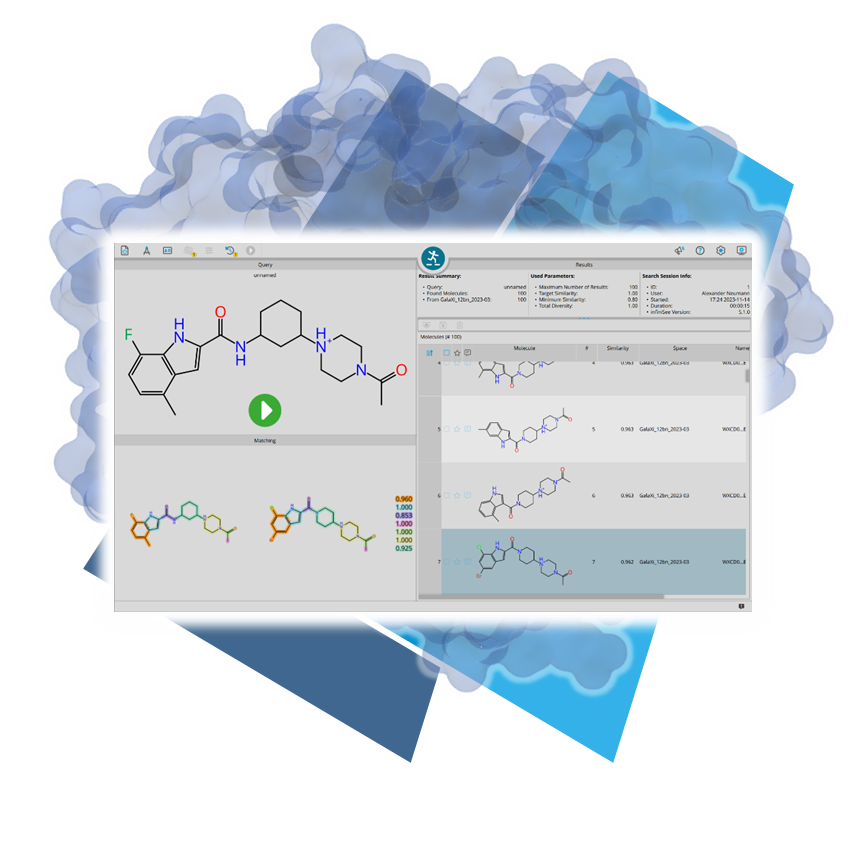
Like other combinatorial Chemical Spaces, the Freedom Space is stored as synthons and reaction rules rather than as a list of enumerated molecules. Every compatible combination of synthons defines a product, which is how a few hundred thousand building blocks expand into hundreds of billions of molecules. infiniSee assembles these products on the fly during a search, so the full space never has to be enumerated.
The Freedom Space is designed to complement Enamine’s REAL Space, with close to zero overlap between the two. Searching both widens the hunting grounds for every query

A Valuable Resource for Various Needs

Besides the full synthon-based space, Chemspace offers Freedom Space 5.0 as three ready-to-download enumerated subsets of 5 billion molecules each.

5B Rule of Five (Ro5)
  • MW: up to 500 Da
  • logP: ≤ 5
  • H-bond donors: up to 5
  • H-bond acceptors: up to 10
5B Rule of Five (Ro5)
Larger, more complex molecules for challenging targets, including PROTAC-like compounds, peptidomimetics, and compounds targeting protein–protein interactions.
  • MW: 500–800 Da
  • logP: ≤ 6
  • H-bond donors: up to 8
  • H-bond acceptors: up to 15
5B Diversity
A representative subset from the full space that covers both Ro5 and bRo5 regions. A perfect starting point for a general project covering a broad range of properties and chemotypes.
Each subset is also available as 0.1%, 1%, and 10% sample sets (5M, 50M, and 500M molecules) to test workflows and estimate computing requirements before scaling up. Chemspace additionally provides focused and covalent subsets:
  • Focused: lead-like (100M), fragments following the Rule of Three (12M), natural product-like (100M), CNS-targeted (100M), agrochemical (5M), and cereblon (CRBN) molecular glues (615M)
  • Covalent: acrylamides (100M), butynamides (11M), and chloroacetamides (96K)

Innovational Machine-Learning-Based Filters

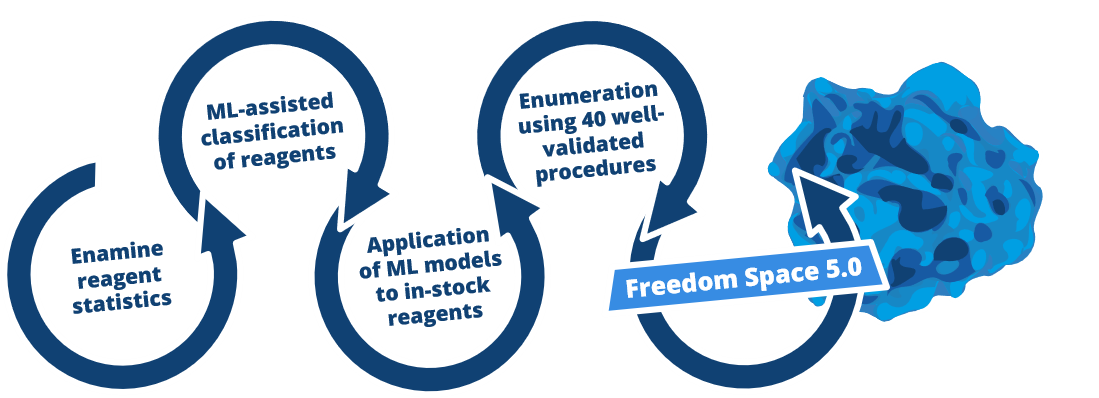
Achieving high synthetic accessibility of a space requires selecting building blocks that perform well in the reactions they undergo. Traditionally, this has been accomplished through large-scale validation, manual selection, or the use of general reaction prediction models.

For the Freedom Space, Chemspace has automated this selection with machine learning. The models are trained on reaction success data collected by Enamine over years of REAL Space synthesis. In addition to diverse, high-quality datasets, the models utilize a custom synthon-building-block molecular representation, which enables them to correctly handle building blocks that yield the same synthon but differ in their functional groups. Every building block pool is filtered by its own dedicated model before the space is assembled.

Chemspace tracks the synthesis success of ordered compounds continuously, and the rate for Freedom Space 5.0 remains above 80%. The approach was first validated in a peer-reviewed study of Freedom Space 3.0, in which more than 80% of 700 selected molecules were successfully synthesized within 5–6 weeks.[1]

Eager to Learn More?

Subset downloads, ordering details, and Chemspace’s custom Chemical Space generation service are available on the Chemspace website.