Chemical Space Generation

Setting Up Your Own Chemical Space

Combinatorial Chemical Spaces are the largest catalogs and hunting grounds for synthesizable compounds. Among trillions+ of compounds, countless candidates are hidden that could become the key to the success of a discovery campaign.
An in-house Chemical Space mobilizes the potential of your own resources to generate novel IP and to benefit internally from the possibilities of these molecular giants.

The Potential Recognized by Global Players

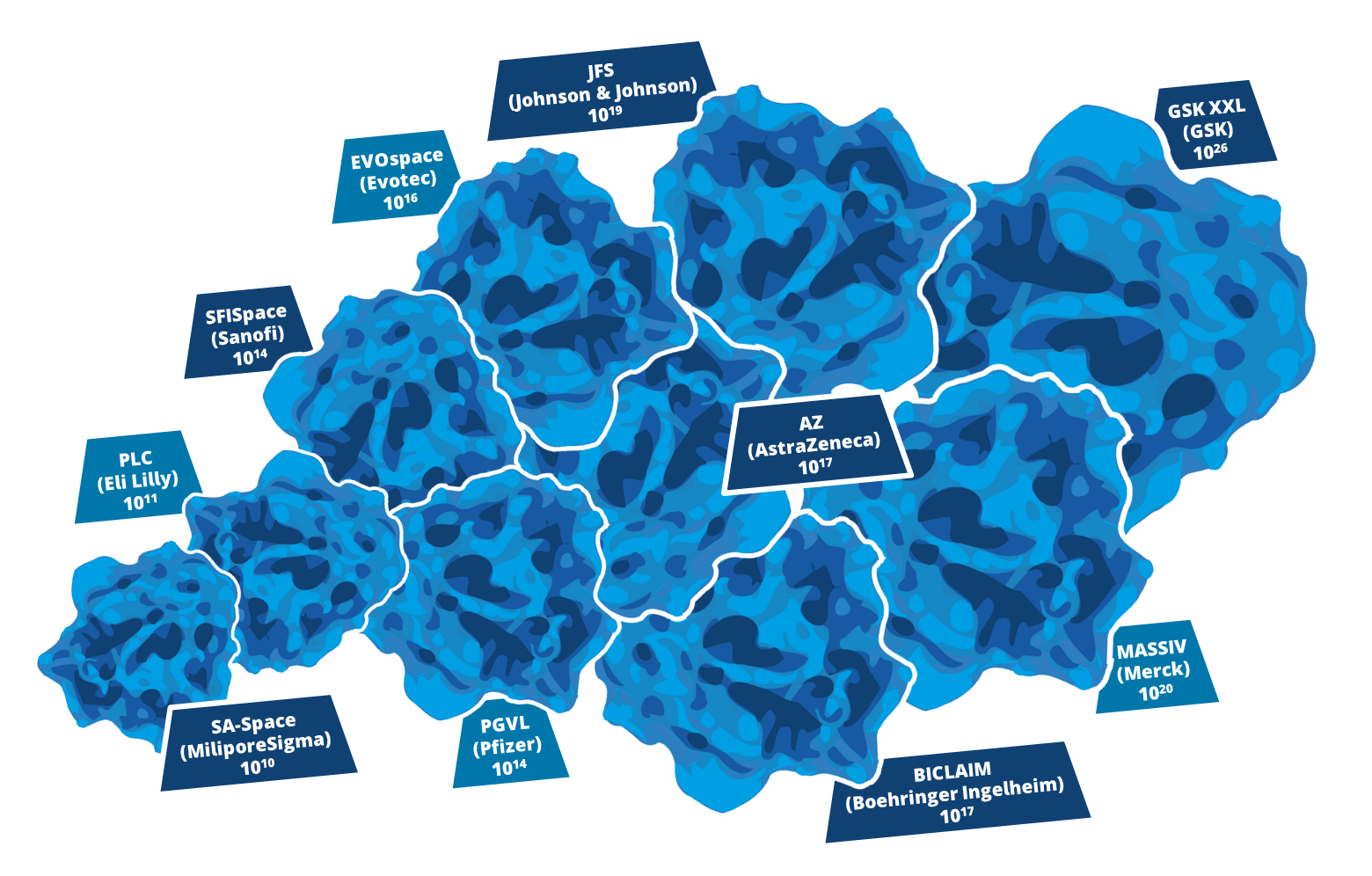
Chemical Spaces have already become an industry standard to accelerate processes and more efficiently access new chemotypes. In addition to AstraZeneca, Boehringer Ingelheim, Eli Lilly, Evotec, GSK, Johnson & Johnson, Merck, MilliporeSigma, Pfizer, and Sanofi, many other companies in the pharmaceutical and cosmetics industries use combinatorial technology in their projects.

Their versatility in practice and their ability to deliver results are described in numerous peer-reviewed publications.
What Chemical Spaces Bring to the Table

1. Strategic Differentiation

Probably the most important unique selling point of individual Chemical Spaces is their uniqueness.
  • By setting up your own compound collection, you create a proprietary chemical universe.
  • Studies have reported that overlap among Chemical Spaces is minimal, meaning that each Space contributes access to additional, unique chemical regions.
  • Any emerging chemotypes are more likely to be truly novel. This is especially valuable for:
    • Patenting
    • Partnering
    • Attracting investors

2. Balance between Novelty and Synthesizability

The content of Chemical Spaces is synthetically realistic.
  • Only one or two-step chemistry is required to realize products, contributing to high synthesis success rates.
  • Retrieved chemistry can be novel while avoid the problems of de novo design (e.g., exotic, impractical, or even impossible to make).
  • Chemotypes can be creative, but are grounded in real chemistry.

3. Massive Scaling with Intelligent Exploration

Not only do they feature several orders of magnitude more compounds than old-fashioned compound catalogs, but can be screened even faster.
  • Billions or even trillions and more can be achieved with a custom Space.
  • Several 2D and 3D methods are available to explore the Chemical Spaces smarter without wasting many computational resources.
  • Unexpected chemotypes can still be discovered without relying on brute-force docking or blind screening.
  • A custom Chemical Space comes with originality and control.

4. Faster Iteration Cycles

Your ultra-large virtual compound collection can grow with the needs of the projects and be adapted.
  • The initial version of your Chemical Space can be refined based on a run cycle of a campaign.
    • Add new building blocks to expand the possibilities around discovered actives.
    • Remove unproductive reagents and reactions to improve success rates.
    • Adjust reaction schemes.
  • The DMTA (design, make, test, analyze) cycle is accelerated with the Space technology as an engine for making more informed decision and improved access to relevant structures.
  • Over time, your Space becomes more optimized and efficient for your specific drug discovery challenges.

5. Tailored to Your Target

While generic compound collections try to provide a broad chemical coverage, your Chemical Space can be designed to provide custom solutions to your target.
  • Employing specific building blocks and reactions leads to population of scaffold areas that display pharmacological activity at your target.
  • Chemical Spaces provide more related compound to a compound of interest and have a broader chemical coverage compared to enumerated libraries.
  • Undesired chemistry can explicitly be excluded (e.g., structures responsible for toxicity, off-target effects, solubility issues).
  • Chemical Spaces can be mined for molecules to create custom sublibraries.

How to Set Up a Chemical Space

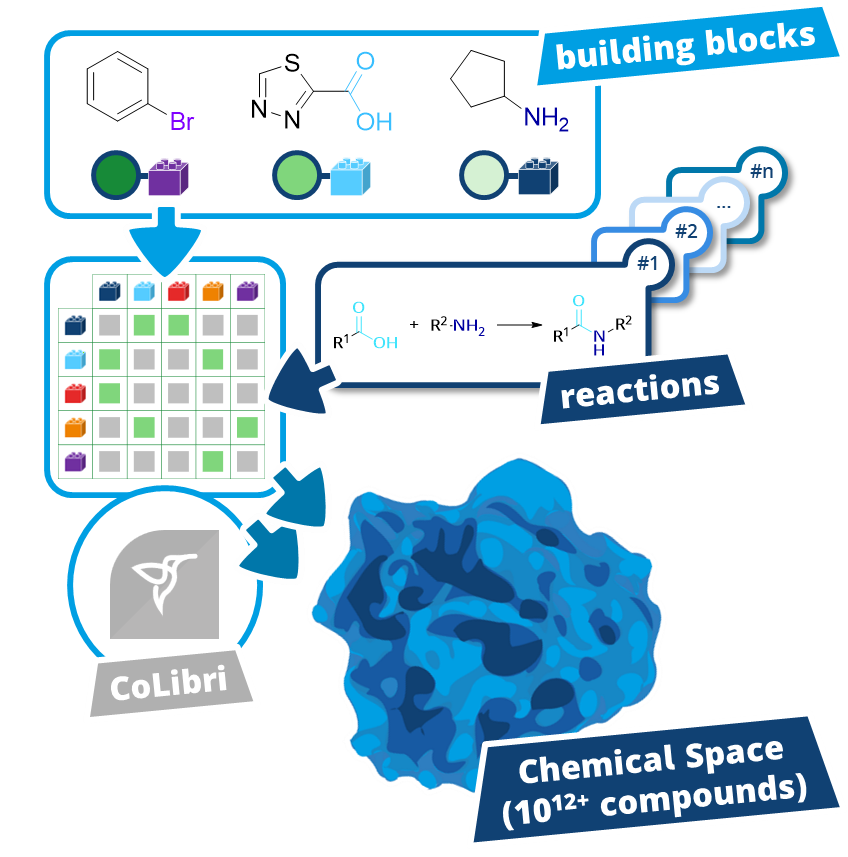
Creating a Chemical Space is surprisingly simple: you need building blocks (compounds with functionalizable groups) and reactions (rules for how to combine them).
In advance, you should not worry too much about the number of building blocks or reactions. Due to combinatorics, even a small number of simple reactions already leads to exponential generation of products. Thus, even just a few thousand building blocks can open up trillions of possibilities.

Reactions can be derived from common databases. Alternatively, our Cookbook offers a selection of proven and robust reactions that can be used as a starting point for further extensions and adaptations.

The generation of the Chemical Space file (.space) is achieved with our tool CoLibri.

There Is No Reason to Wait

Literally ANYONE can set up a Chemical Space. CoLibri can be conveniently downloaded with just one click and tested right away.

Download CoLibri 9.0 for your operating system:

Get your CoLibri license:

Want to Know More?

How Do Medicinal Chemists Benefit from a Chemical Space?

Medicinal chemists are central to realizing the full value of a Chemical Space, since they can interpret it and guide its evolution.
  • They can:
    • Cherry-pick building blocks to increase the chemical diversity or to cover desired scaffolds.
    • Encode their intuition into the Space design via reaction schemes.
    • Assess the quality of retrieved results.
  • The contribution makes the process more interpretable, more collaborative, and elevates the results beyond the scopes of de novo generated proposals.

How Do Small Teams Benefit from a Chemical Space?

Setting up your own Chemical Space comes with strategic advantages that make you more flexible and efficient.
  • Embedding a Chemical Space into your workflow enables you to concentrate your limited resources on the most high-value regions of chemistry.
  • Time and cost are conserved by minimizing the synthesis of low-priority or irrelevant compounds.
  • Higher-quality hits can be identified more rapidly, enabling faster progress and earlier insights.

How Can I Search Chemical Spaces?

2D: infiniSee

infiniSee is a Chemical Space navigation platform with an intuitive GUI that retrieves compounds based on different aspects of molecular similarity.

2D: FTrees (Scaffold Hopper)

Rapidly identifies structurally diverse compounds with similar functionalities, enabling scaffold hopping and exploration of novel core chemistries.

2D: SpaceLight (Analog Hunter)

The fastest method (though all are exceptionally fast) for identifying close chemical analogs in the chemical proximity of a compound of interest to enable SAR exploration.

2D: SpaceMACS (Motif Matcher)

Searches for defined substructure and shared common motifs to find compounds sharing key functional features.
CLI supports SMARTS searches.

3D: Chemical Space Docking®

Structure-based exploration of ultra-large combinatorial spaces to discover novel, synthetically accessible binders with favorable interactions in the target's binding site.

How Can I Search Chemical Spaces?

FTrees, SpaceLight and SpaceMACS are available as stand-alone command-line tools, as well as Modes in infiniSee.
Chemical Space Docking® can be accessed within SeeSAR in combination with HPSee.

Vendor Chemical Spaces

We run several collaborations with trusted partners (WuXi, OTAVA, Enamine, Ambinter, Chemspace, Synple, eMolecule) who provide their Chemical Spaces as the largest compound catalogs available for users to search. In an on-demand model, requested compounds are then synthesized and shipped to the end customer, giving them access to the maximum possible number of synthesizable molecules.

If you would like to make your own compound vendor space available in collaboration with us, please contact us via the contact form.