Chemical Space Exploration

Chemical Space Exploration

Chemical Space exploration comes in different shapes and colors and can be roughly divided into two camps: the construction of Chemical Spaces and the directed search within those. The aim of the first is to build up a collection of molecules or chemical entities that either exhausts all possibilities or covers a focused part of the total. Once generated, Chemical Spaces can be searched for molecules with specific properties that comply with the needs of the projects (e.g., drug discovery, chemical catalysts, cosmetics, etc.).
We have collected some aspects and examples of the Chemical Space exploration with applications from drug discovery and medicinal chemistry.

Accelerated Structure-Activity Relationship Elucidation

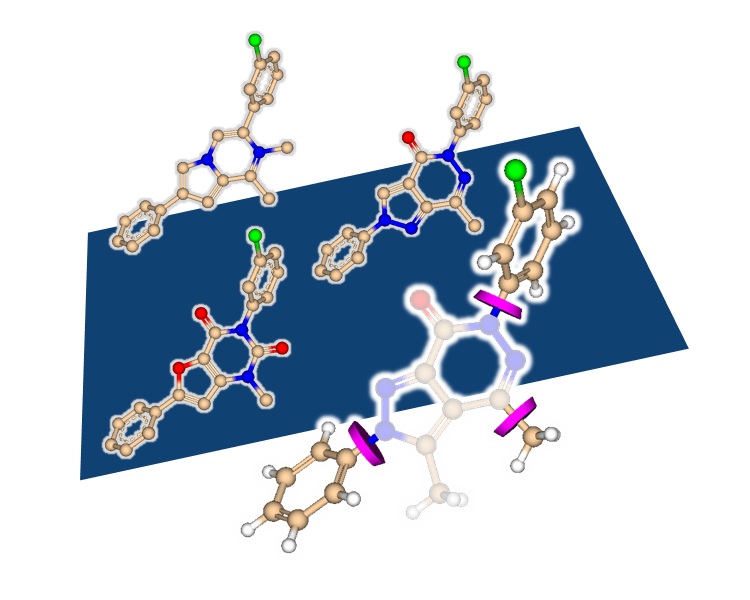
Klingler et al. introduced the concept of "SAR by Space" (SAR = structure-activity relationship; you may have heard of "SAR by NMR" by Abbott, or "SAR by Catalog" by Astex). This method aims to accelerate early stages of drug discovery by utilizing the accessibility of compounds from vendors. The premise is simple: Starting with a query molecule, scientists can search in vast make-on-demand Chemical Spaces for related compounds and analogs. Molecules of interest can be ordered and synthesized within weeks.
This approach has several perks: Companies without in-house facilities can cost-efficiently advance their projects in a short period of time. Furthermore, the increasing number of commercial Chemical Spaces increases diversity and possibilities to find interesting follow-ups.

Ring systems and their bioisosteric replacements

Peter Ertl extracted bioactive ring systems and their respective targets from a billion of drug-like molecules resulting in the creation of a ring Chemical Space with almost 40,000 molecular scaffolds.
Rings represent privileged motives in medicinal chemistry as they define the shape of the molecule, are responsible for the orientation of attached groups and often contribute to the binding affinity on their own. Yet sometimes ring replacement (also described as scaffold replacement) is required due to promiscuity of the system, unfavored physicochemical properties, toxicity issues, or intellectual property claims.

BioSolveIT software tackles this problem with the scaffold replacement tool ReCore and infiniSee that performs fuzzy pharmacophore search for distant neighbors to a query molecule.

The interactive browser application from the publication can be accessed here.
Navigation in the Ring Chemical Space Guided by the Bioactive Rings.
Ertl, P.
J. Chem. Inf. Model. 2021.

Enumeration of accessible molecules

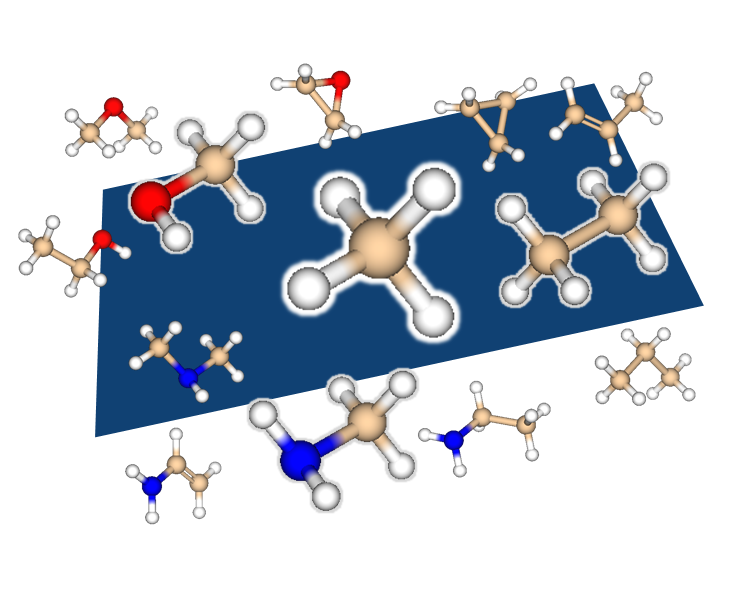
The Reymond group from the University of Bern in Switzerland made their efforts to enumerate small organic molecules leading to the GDB databases. The numbering of the data sets specifies how many heavy atoms were used for the construction of the Chemical Space. Users can use the sets for virtual screening (e.g. with SeeSAR or FlexX) to search for synthetically accessible compounds.
Enumerated data sets require a vast amount of storage to be processed. Hits from combinatorial spaces on the other hand are built up during the search, thus lowering the computational requirements.
New Resource: Master Your Own Chemical Space
March 11, 2026 12:09 CET
In the evolving landscape of drug discovery, the focus has shifted from merely searching external catalogs to the active creation of internal chemical universes. We are pleased to announce a comprehensive new resource page dedicated to Chemical Space Generation. This hub explores how teams can leverage combinatorial technology to gain...
Read on
Freedom Space by Chemspace March 2026 Update - Now a MASSIVE 296 Billion!
March 5, 2026 10:09 CET
The March 2026 update of Freedom Space brings a significant expansion, now featuring over 296 billion accessible, drug-like products. Created by Chemspace, this collection was built from 39 reaction protocols and 215,000 reagents sourced from 15 of the most reliable suppliers. By prioritizing price and lead time, this version enhances...
Read on
category
Events
Tool of the Month - SpaceMACS
February 26, 2026 14:08 CET
Spotlight on SpaceMACS: Precision Substructure Mining at Scale In the search for the next lead candidate, medicinal chemists often focus on specific structural motifs while requiring absolute synthetic accessibility. This month, we focus on SpaceMACS, our specialized algorithm designed to perform rapid substructure searches across trillions of compounds within massive...
Read on

Be part of the Chemical Space community on LinkedIn!

string(26) "background-color: #104173;"