







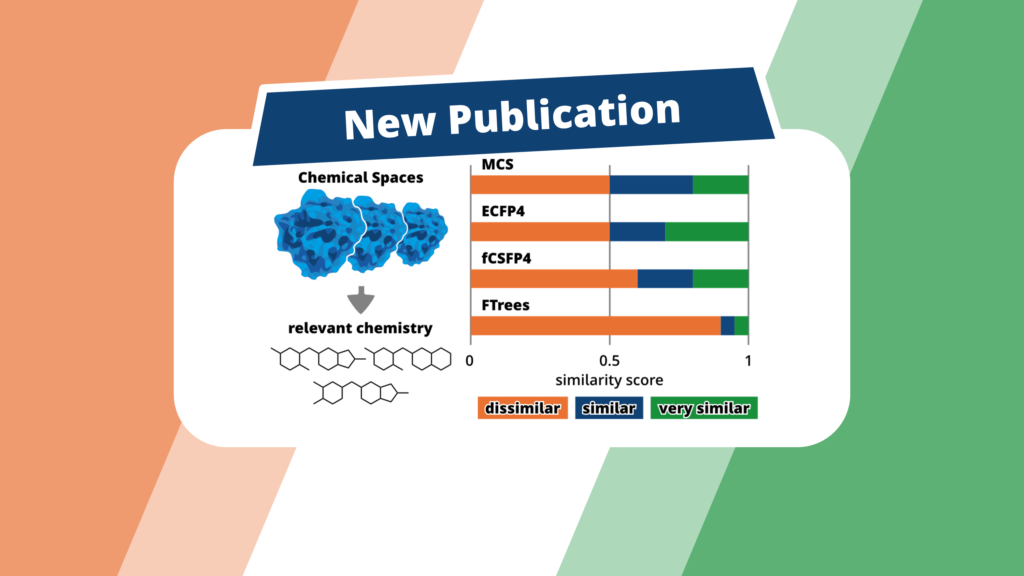

In collaboration with Pfizer, our team recently published a study in the Journal of Chemical Information and Modeling. The work represents fundamental research into molecular similarity, extended to ultra-large, combinatorial Chemical Spaces.
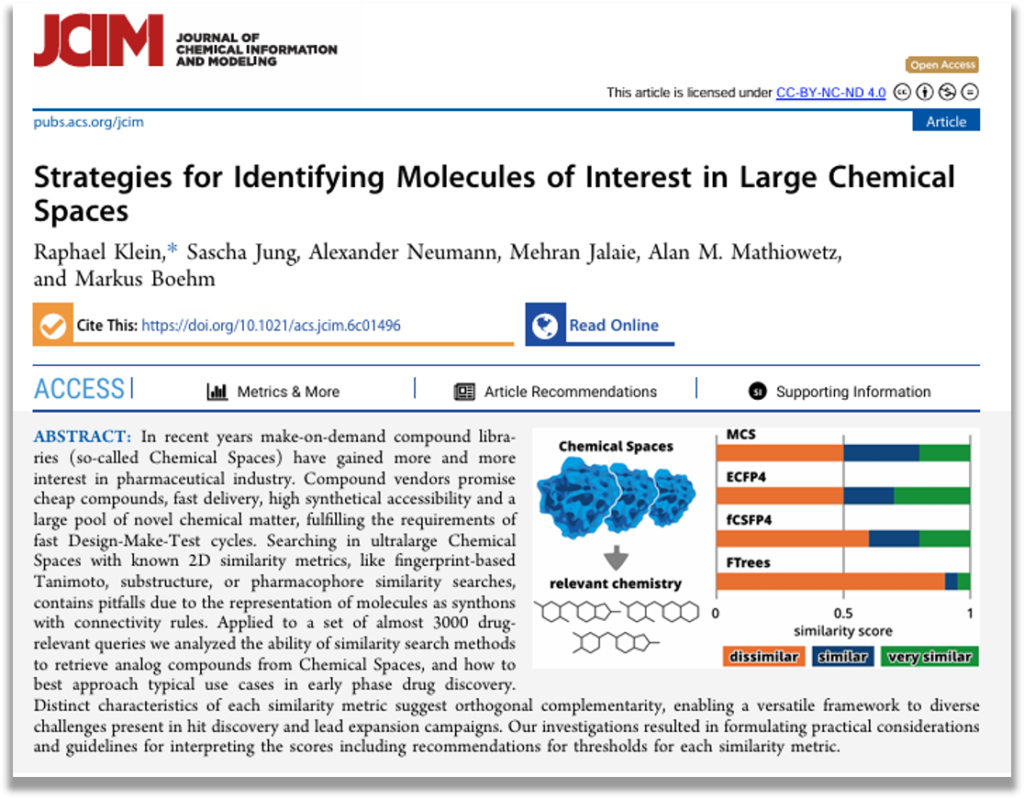
Read the Full Publication (Open Access)
Which Central Questions Were Addressed?
- Which similarity-score thresholds are meaningful?
- How do the different Chemical Space search algorithms (SpaceLight, SpaceMACS, FTrees) compare?
- What are the pitfalls of conventional fingerprints in synthon-based Chemical Spaces?
Major Findings
- Each similarity method provides relevant, unique chemistry.
SpaceLight, SpaceMACS, and FTrees retrieve largely complementary sets of compounds and should be selected according to the intended use case. - Exact matches alone are a poor measure of Chemical Space relevance.
The density and quality of close analogs around a query are more informative for hit expansion and SAR-by-Space campaigns. - fCSFP4 is the recommended default fingerprint for Chemical Space searching.
It provides the best balance between analog retrieval and meaningful separation of identical, similar, and dissimilar compounds. - Common medicinal chemistry transformations affect similarity scores very differently.
Bioisosteric replacements, ring changes, and central linker modifications can cause unexpectedly large score reductions. - FTrees provides an orthogonal scaffold-hopping perspective.
It tolerates broader structural changes and can identify pharmacophorically related compounds that fingerprint- and MCS-based methods may miss. - Similarity scores cannot be interpreted uniformly across methods.
Each algorithm operates within a different dynamic range and therefore requires its own thresholds among the similarity groups. - Combining methods provides the broadest chemical coverage.
Only a small fraction of results were shared across all three search engines, demonstrating that they explore substantially different regions of the Chemical Space.
We congratulate the authors on this landmark publication, which will undoubtedly have a lasting impact on Chemical Space navigation, and extend our special thanks to the outstanding team at Pfizer for the wonderful and highly productive collaboration!