









This Summer, You Wear Molecule Alignment
This July, see Similarity in 3D with FlexS as BioSolveIT’s Tool of the Month.
In ligand-based drug discovery, the most interesting molecules are not always the ones that look similar on paper. Sometimes, the true connection only becomes visible in 3D. FlexS helps uncover these relationships by aligning compounds based on their spatial arrangement, shape, volume, and interaction features.
What Does FlexS Do?
- Aligns ligands in 3D: FlexS superposes molecules based on their 3D shape, volume, and interaction features, helping you see whether compounds occupy similar molecular space.
- Supports ligand-based virtual screening: When no protein structure is available, FlexS can use a known active ligand as a reference to identify other compounds with similar 3D properties.
- Helps with scaffold hopping: FlexS can reveal compounds with different 2D structures but similar 3D arrangements, making it useful for finding new chemotypes.
- Adds a 3D perspective to SAR exploration: FlexS helps compare compound series beyond simple 2D similarity, supporting the interpretation of activity trends and functional group replacements.
How Does FlexS Work?
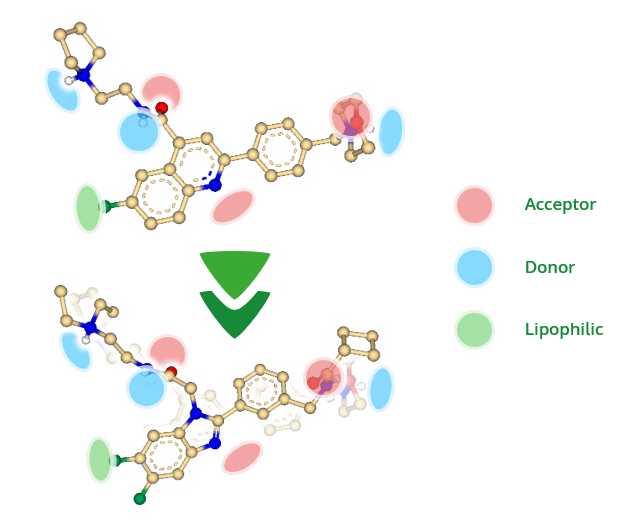
FlexS starts with one or more reference ligands (up to five) and aligns other molecules onto them in 3D. Instead of simply comparing 2D structures, FlexS evaluates how well compounds match in shape, volume, and interaction features. The algorithm explores possible conformations and orientations of a query molecule and searches for the best possible superposition with the reference ligand. This helps identify compounds that may occupy similar chemical space, even if their scaffolds look different on paper. The result is a meaningful 3D alignment.
Why Use FlexS?
FlexS is the method of choice for researchers who need to navigate the three-dimensional landscape of drug discovery when a target structure is unknown or unavailable. By leveraging known binders, FlexS allows you to use a reference ligand as a “negative fingerprint” of the active site, enabling rational design even in the absence of a protein crystal structure.
- Scientifically Validated Accuracy: Built on sophisticated physico-chemical models, the FlexS algorithm has been proven to reproduce bioactive binding conformations with a root-mean-square-deviation (RMSD) below 1.5 Å in more than 60% of studied cases.
- High-Speed Virtual Screening: FlexS is designed for efficiency, typically taking less than 2 minutes per predicted superposition. This speed makes it ideal for prioritizing large compound libraries for experimental testing.
- Guided Alignment with Pharmacophores: Unlike post-processing filters, FlexS allows you to apply pharmacophore constraints during the alignment step. This ensures the algorithm actively explores the solution space for poses that obey your specific design hypotheses, leading to more relevant results.
- SeeSAR’s Activity Spotter depends on meaningful 3D alignments of active and inactive compounds to identify features that drive or prevent biological activity. FlexS is a natural companion here: it helps align diverse ligands in 3D, even across different scaffolds, so Activity Spotter can compare them in a shared spatial context. Better alignments lead to clearer activity and inactivity spots, stronger SAR interpretation, and more actionable pharmacophore constraints for follow-up design and screening.
Access the Tool of the Month!
You will receive full access to FlexS for the entire month of July.
Download your license, align your compounds, and discover what 3D similarity can reveal.
The license will be valid until July 31, 2026 and can be used for: